
Foosball Wall Pass vs. Brush Pass
The wall pass and the brush pass are the two fundamental ways to move the ball from your 5-bar (midfield rod) to your 3-bar…
Great foosball goalie defense comes down to two things: positioning your goalie and 2-bar rods to cut angles, and moving them together as a coordinated unit ...
Great foosball goalie defense comes down to two things: positioning your goalie and 2-bar rods to cut angles, and moving them together as a coordinated unit — not as two separate afterthoughts. Whether you’re playing Tornado at your school or grinding a Wednesday DYP, a disciplined two-man defense stops more shots than raw reflexes ever will. Here’s exactly how to build it.
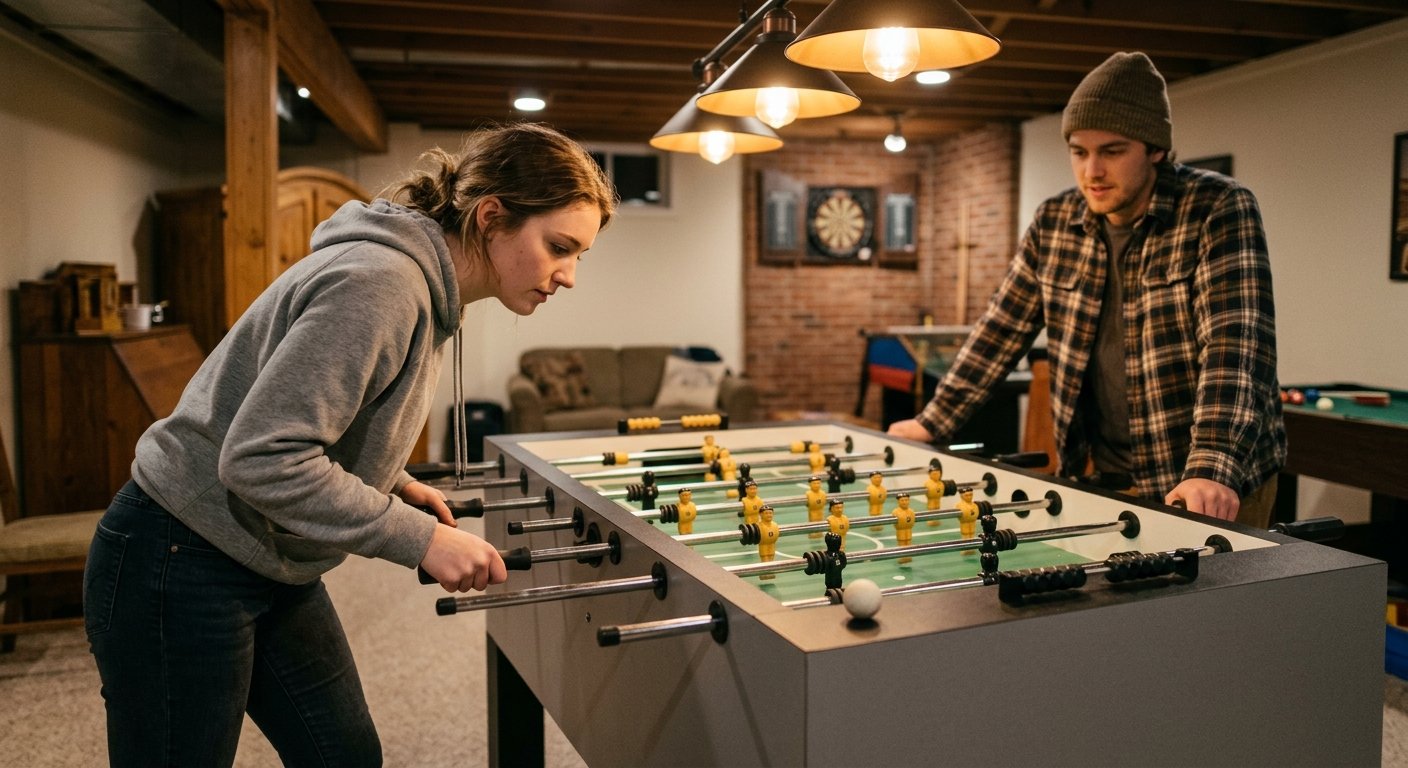
Most beginners treat the goalie rod the way people treat their car’s spare tire — only noticed after something goes wrong. Competitive players know the goalie rod is an offensive weapon in disguise. On a Tornado table, the goalie rod carries three men positioned low near your own goal. A clean goalie catch and pass up to your 5-bar (midfield rod) can flip field position in under two seconds. The defense starts the attack.
That dual role — shot-stopper and ball distributor — is why foosball goalie techniques deserve dedicated practice time, not just improvised wiggling when the ball rolls that direction.
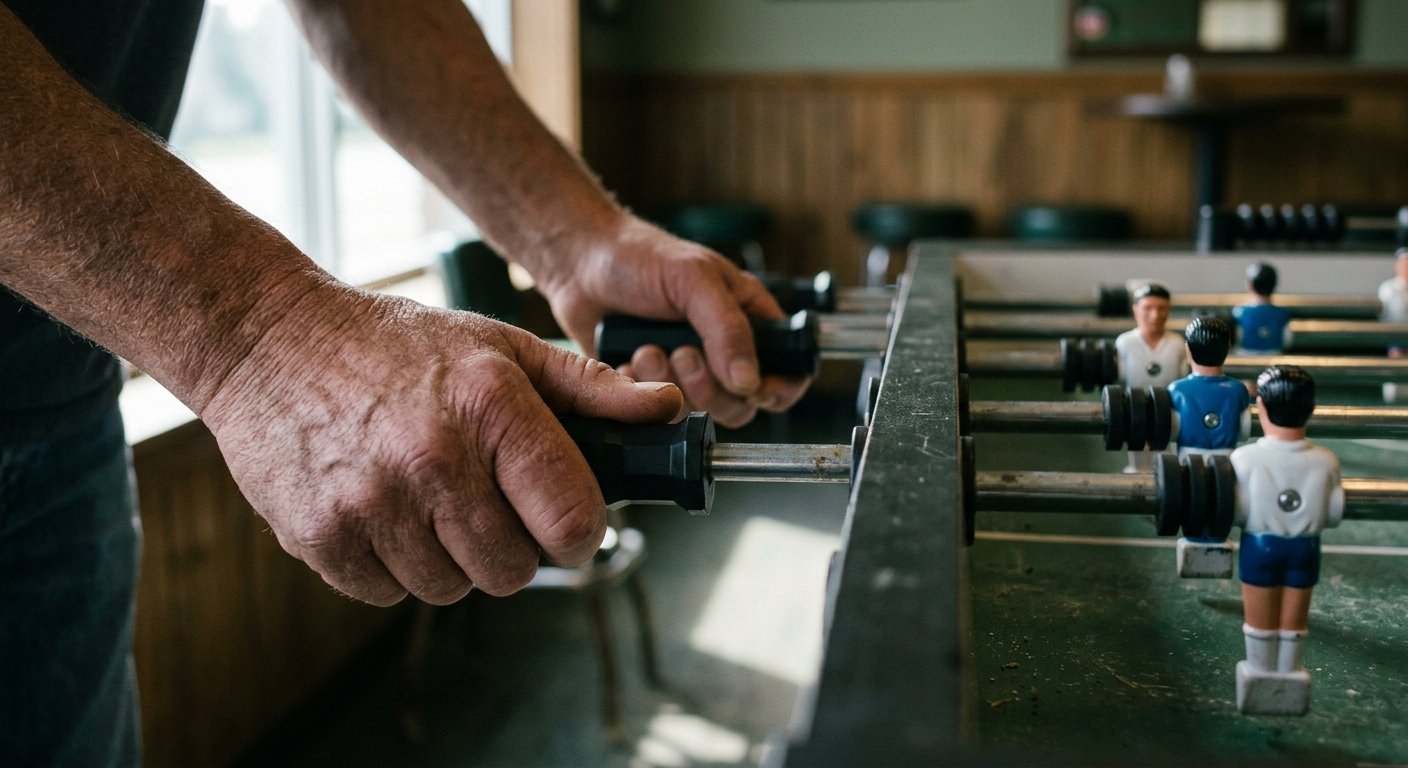
On a standard Tornado table, each side has four rods: goalie (3 men), 2-bar defense (2 men), 5-bar midfield, and 3-bar offense. The goalie and 2-bar together form your defensive wall. They must be coordinated because a gap between them is exactly what a skilled shooter aims for.
Flat positioning — both rods’ men aligned at exactly the same lateral point — creates a predictable gap down the middle. Staggered positioning means your 2-bar men and goalie men are offset by roughly one man-width, so the two rods collectively cover more of the goal mouth. Think of it like staggering bricks in a wall. No straight line runs through.
Your default starting position when the opponent has the ball on their 3-bar: goalie rod centered, 2-bar shifted slightly toward the ball side. When the ball moves, the 2-bar tracks the ball; the goalie mirrors but stays half a beat behind, filling the gap the 2-bar leaves.
Put your goalie rod hand at the center grip and your 2-bar hand slightly toward the near rail when your opponent has the ball on their right side. You’re already pre-loaded for the most common angle shot before it launches.
New players watch the opponent’s rod. Experienced players watch the ball. The rod is a feint tool — shooters wiggle it, stall, shift the man back and forth. The ball tells the truth. When the ball leaves neutral contact and rides slightly toward the man’s foot, the shot is within the next half-second. Keep your peripheral vision on the ball position at all times.
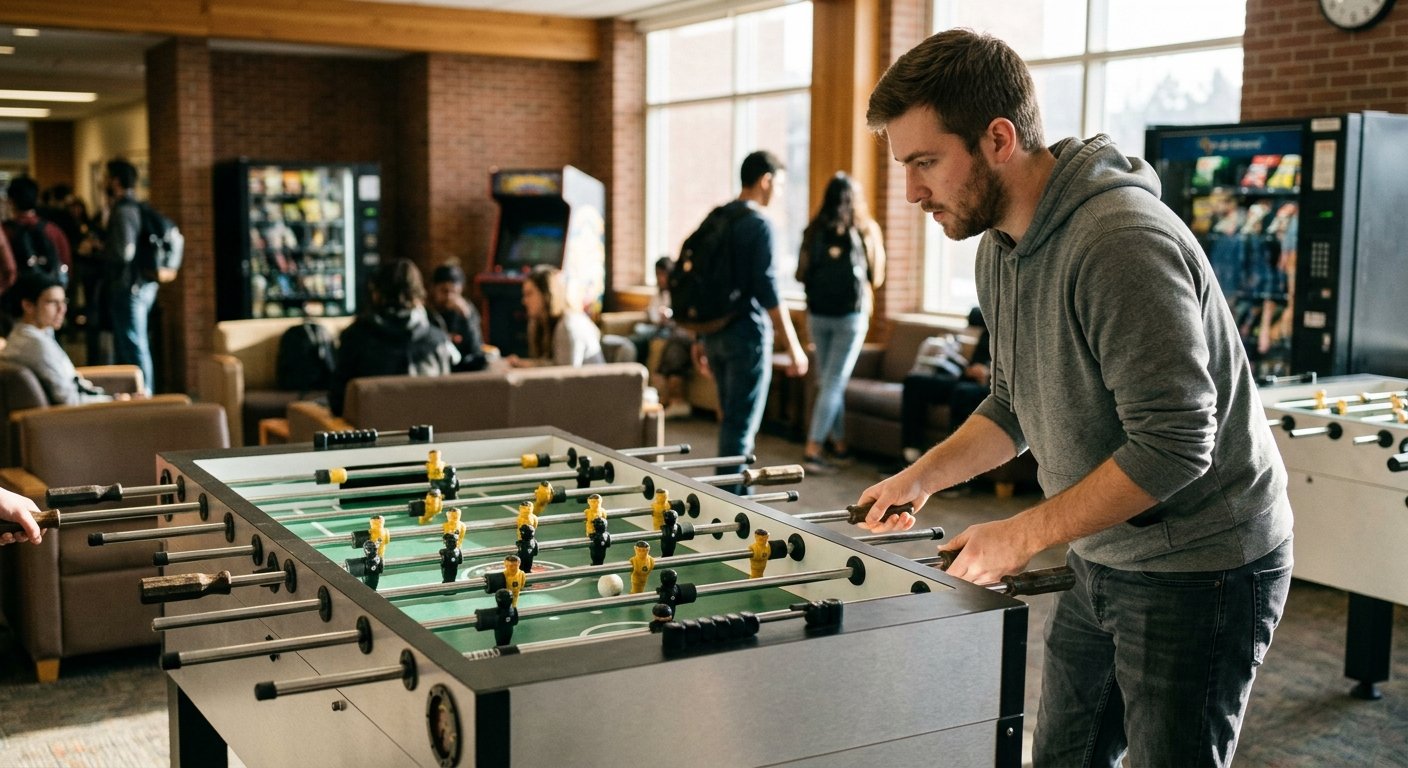
Every defensively sound foosball player internalizes three patterns. These aren’t reactions — they’re pre-set positions you move into based on where the ball is.
When the shooter sets up toward the near rail (closest to your hand side), their pull shot (a lateral move outward followed by a strike) targets the near post. Pre-load your 2-bar toward that rail. Your goalie stays one man-width toward center. You cover the near angle and leave the far post slightly exposed — but a far-post shot from a near-rail setup requires an extraordinary pass or a very wide spray (an angled shot that redirects off the wall). The odds favor your position.
A ball set dead-center on the opponent’s 3-bar (between the middle man’s feet, roughly) signals a straight shot, a snake/rollover (ball pinned under the man’s foot, then fired with a wrist rollover), or a pass to a wide man. Both your rods should be centered and staggered. Do not drift. The snake is fast, but it telegraphs: watch for the front pin (ball resting against the front of the foot) and be ready to drop the 2-bar straight down on release.
A push shot (the mirror of the pull — lateral move inward, then strike) targets the far post. Shift your 2-bar toward the far rail and your goalie one step behind. This is the hardest pattern to hold because it feels like you’re giving up the near post. You are — slightly. But the push to far post is a lower-percentage shot for most recreational players, and staying disciplined in your positioning beats scrambling every time.
| Ball Position on Opponent’s 3-Bar | 2-Bar Default | Goalie Default |
|---|---|---|
| Near rail (pull shot side) | Shift toward near rail | Hold center, slight near lean |
| Dead center | Centered, staggered | Centered, staggered |
| Far rail (push shot side) | Shift toward far rail | Hold center, slight far lean |
Reading positioning is a mental skill. Moving fast enough to use it is a physical one. These drills train both.
Set up with just a goalie rod and a ball. Place the ball at the near rail of your own goal. Sweep the goalie rod smoothly from rail to rail five times without stopping, keeping the men parallel and flat. Time yourself. Then do it again with a slight rotation — men angled 15 degrees forward — to practice blocking deflections. Do three sets of ten sweeps before every session. It sounds boring. It builds the fast-twitch muscle memory that blocks the late-game snake.
Have a partner shoot freely from their 3-bar while you only use your goalie and 2-bar to defend. No counterattacking. Just defense. Do this for five-minute rounds. The first round you’ll get torched. By the third round, your patterns click in. This is the most direct foosball defense strategy drill there is because it simulates real game pressure without the cognitive load of also thinking about offense.
A spray shot bounces the ball off the near rail before it reaches the goal. Set your 2-bar to near-rail position and have your partner spray repeatedly from various 3-bar positions. Your job is to anticipate the deflection angle and move the goalie to meet the ball after the bounce. Angles are predictable — physics doesn’t lie — and this drill trains your eye to see them automatically.
Under standard Tornado tournament rules, you have 15 seconds of possession per rod (10 seconds on the 5-bar). If you’re drilling live defense, know that a patient shooter is using that clock strategically — don’t let the stall break your positioning. The USA Foosball / USTSF rulebook covers all possession timing and timeout rules if you want the full spec.
A blocked shot that stays with your goalie rod is a possession, not just a save. Top players catch the ball with their goalie, set it deliberately, and push it to the 2-bar or pass up to the 5-bar within their possession window. This is how you go from surviving to winning.
Practice the goalie-to-2-bar wall pass: park the ball between your goalie’s near man and the rail, then brush it laterally along the rail to your 2-bar man’s foot. Clean, quiet, fast. From the 2-bar you can continue up to the 5-bar for a full counterattack. If you only ever block and hope, you’re playing defense permanently. If you can clean the ball and distribute, you’re playing chess.
A blocked shot that stays with your goalie rod is a possession, not just a save.
For more on passing mechanics and 5-bar strategy, the techniques and skills section at Foos Central goes deep on every rod — goalie, 2-bar, midfield and 3-bar offense — with breakdowns you can apply immediately.
The best foosball goalie defense is partly anticipatory. Here are three things skilled shooters do that telegraph their shot:
These reads come from time at the table, but knowing what to look for accelerates the learning curve significantly. The ITSF (International Table Soccer Federation) recognizes foosball as a competitive sport internationally — the level of tactical depth in play at that level makes these reads standard, not advanced.
The best default is a staggered position: goalie rod centered and 2-bar shifted slightly toward the ball side. Staggering the two rods by roughly one man-width eliminates the straight-down-the-middle lane without requiring you to guess the shot direction. Adjust the offset as the ball moves across the opponent’s 3-bar.
Watch for the front pin — the ball resting against the front of the opponent’s middle 3-bar man’s foot. Once you see the pin, pre-position your 2-bar toward the likely shot lane and don’t chase fakes. The snake is fast but requires a visible setup; recognizing the pin gives you a half-beat of anticipation that makes blocking it realistic.
The 2-bar tracks the ball because it’s the first line of defense and closer to the action. The goalie mirrors the 2-bar but stays offset — filling the gap the 2-bar’s movement creates, not chasing the ball independently. Think of the 2-bar as leading and the goalie as filling the shadow behind it.
After a block, set the ball with your goalie rod rather than immediately swinging. Use a wall pass from the near goalie man along the rail to your 2-bar man’s foot, then continue up to the 5-bar. This converts a save into a possession and shifts momentum. Practice the goalie-to-2-bar wall pass in isolation until it’s automatic.
The sweep drill (rail-to-rail goalie movement, three sets of ten) builds lateral speed. Partner live-ball rounds — defend only, no offense — build pattern recognition under pressure. The spray anticipation drill trains you to read ball deflection angles off the rail. All three together cover the mechanical, tactical, and visual dimensions of defense.
Defense wins games, and goalie defense wins tight ones. The staggered position, the three blocking patterns, the outlet pass, the reads — none of this is instinct you either have or don’t. It’s a skill set, and it’s built one session at a time. Start with the sweep drill tonight. Add the partner live-ball rounds this week. Watch how fast your opponents’ sure goals suddenly aren’t.
If you want to test your new defense against real competition, Foos Central has the full South Florida tournament calendar and registration guides at fooscentral.com/tournaments. Find a table near Boca Raton, Fort Lauderdale, West Palm Beach, or Miami at our Where to Play directory — bars, game rooms, clubs and leagues all listed. And if you want to help bring tournament-grade Tornado tables to schools in South Florida, the Youth Program page has everything you need to get involved.
Explore drills, techniques, and where to find a table near you — all at Foos Central.
Grow the game
We put tournament-grade Tornado tables where kids can reach them. Bring the Youth Program to a school near you, or find a table and play tonight.