
Foosball Goalie Defense: Techniques That Work
Great foosball goalie defense comes down to two things: positioning your goalie and 2-bar rods to cut angles, and moving them together as a…
The wall pass and the brush pass are the two fundamental ways to move the ball from your 5-bar (midfield rod) to your 3-bar (offense) in foosball.
The wall pass and the brush pass are the two fundamental ways to move the ball from your 5-bar (midfield rod) to your 3-bar (offense) in foosball. The wall pass uses the table’s side rail as a guide; the brush pass redirects the ball with a glancing touch. Knowing which to use — and when — is what separates players who can pass from players who can actually create shots.
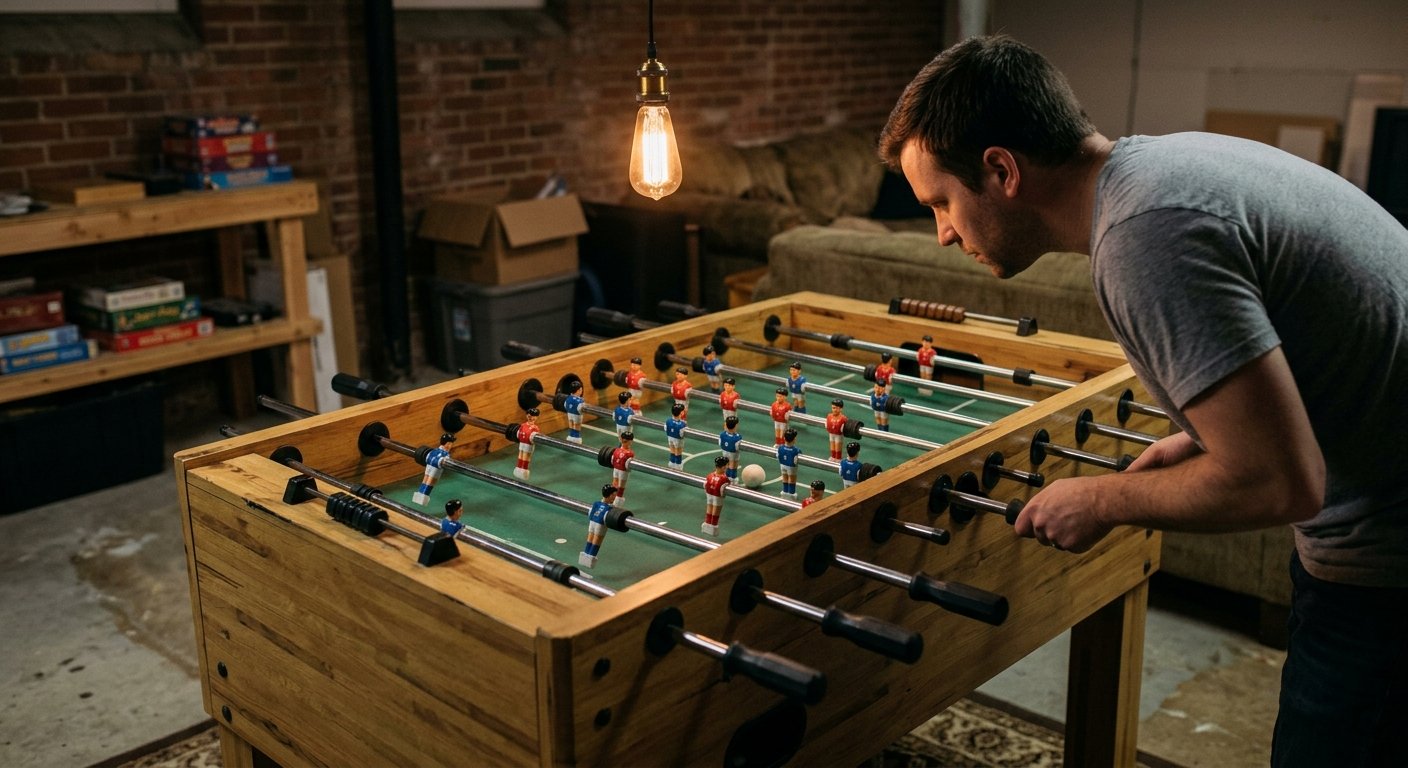
Picture your 5-bar. You have five men spread across the rod, and the outermost man — the one closest to the rail — is your wall-pass man. The wall pass works exactly like it sounds: you place the ball near the rail, angle your outer 5-bar man’s foot toward the near wall, and give it a short, controlled push. The ball travels down the rail and pops out in front of your outside 3-bar man.
The beauty of the wall pass is its simplicity. You don’t need to time a spin or master a wrist snap. The rail keeps the ball on track, and with a little practice, the pass becomes consistent enough to run in game situations. That consistency is also its biggest weakness: a defender who has seen you run the wall three times in a row knows exactly where the ball is going. Competitive players will cheat their 3-bar defense toward the rail and pick that pass off all day.
When you set up a wall pass, vary the receiving man. Your outside 3-bar man is the obvious target, but with a slightly longer push you can push it past a mispositioned defense and catch your middle 3-bar man instead. Defenders have to guard the whole table — make them prove it.
The wall pass also has a rules wrinkle worth knowing. Under standard tournament rules, a ball that is stopped or pinned on the 5-bar must touch two men on that rod before you pass it to the 3-bar. A wall pass from the outer man typically doesn’t require a two-touch — you’re passing freely — but if you’re setting up with a dead-stopped ball, confirm your touch count or you’ll hear a referee call it.
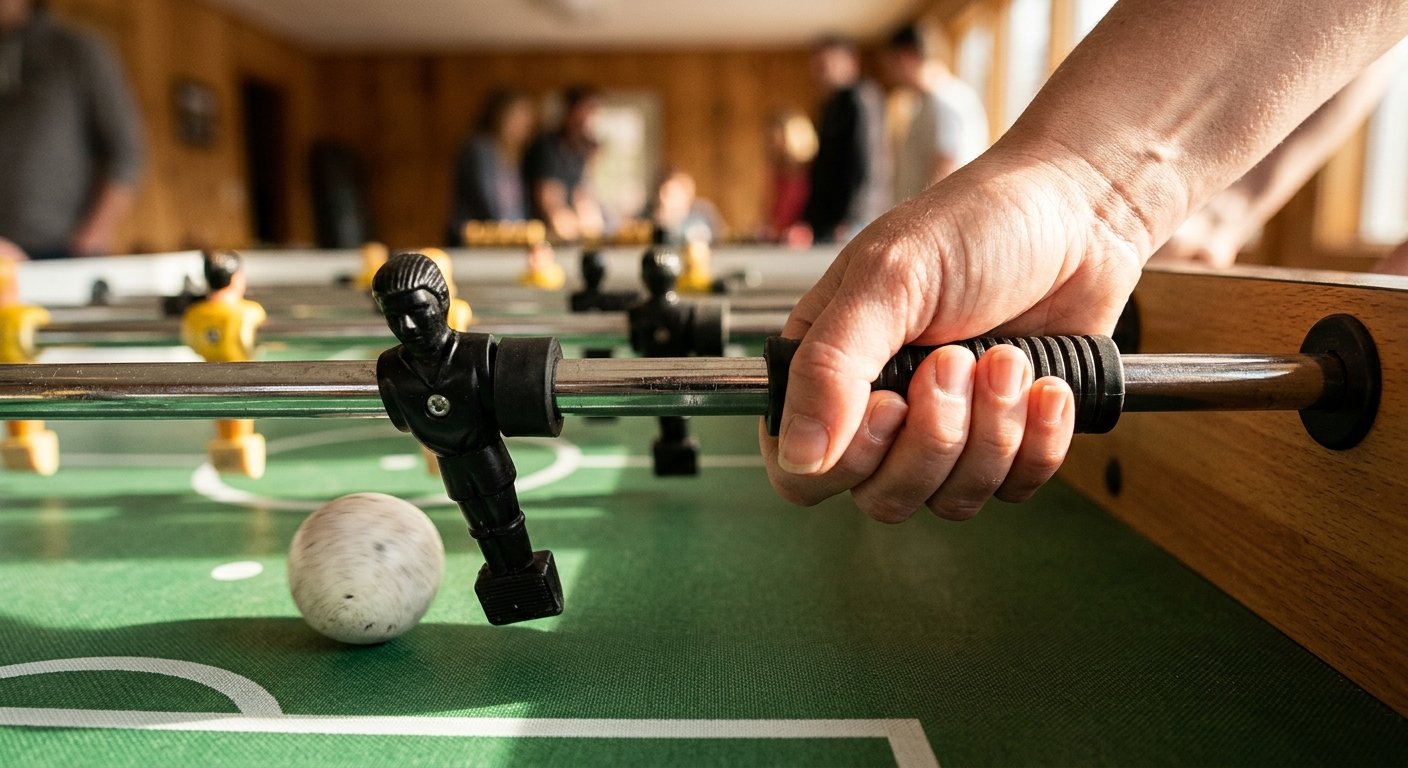
The brush pass is a direction-change shot. Instead of sending the ball straight down the rail or directly across the table, you make glancing contact with the ball at an angle, so it deflects — “brushes” — off your man’s foot and travels on a diagonal toward your 3-bar. Done well, it looks like nothing happened until the ball is already past the defense.
The mechanics take a bit longer to own than the wall pass. You’re timing a lateral rod movement with a precise angle of contact, and the ball’s final path depends heavily on how square or angled your man’s foot is at the moment of contact. A foot that’s too flat sends the ball sideways with no forward momentum. A foot that’s too angled kills your direction control. The sweet spot is somewhere in between, and you find it through deliberate repetition — not just casual play.
Practice the brush pass in isolation: place the ball at mid-table, brush it 20 times aiming for the left lane, then 20 times aiming for the right lane. Don’t worry about 3-bar catches yet — just lock in the angle. Catches come after the pass is repeatable.
What makes the brush pass dangerous is its unpredictability. It can originate from almost any 5-bar man position and change the ball’s direction before a defender can react. That’s particularly valuable against opponents who have locked down the wall lane — you’re forcing them to cover a diagonal they didn’t expect. Check out the techniques library on Foos Central for video breakdowns of brush pass angles from different 5-bar positions.

| Criterion | Wall Pass | Brush Pass |
|---|---|---|
| Difficulty to learn | Lower — rail guides the ball | Higher — angle control is key |
| Predictability | High — easy for defense to read | Low — direction changes mid-path |
| Best against | Defenders playing center-heavy | Defenders cheating toward the rail |
| Set-up time | Quick — ball near rail, push | Requires precise man positioning |
| Catch difficulty | Easier — ball arrives in predictable lane | Harder — diagonal path needs adjustment |
| Mixing potential | Good starting point | Essential for any series |
Neither pass wins this comparison outright, which is the whole point. The wall pass is your baseline: reliable, fast, and effective until your opponent figures it out. The brush pass is your answer when the defense adjusts. The best 5-bar players use both in combination — setting up a wall-pass read, then brushing into the open lane the defense just vacated.
A series in foosball is a pre-planned sequence of passes designed to move the defense and create an opening. The concept is well-established in competitive Tornado play: you don’t just pass — you pass with intention, reading the defense and knowing in advance which option you’ll take when they cheat one direction.
Here’s a simple beginner series built on both passes:
Position your outer 5-bar man near the rail. Let the defense see the wall-pass setup. You’re baiting them to shade their 3-bar defense toward the rail.
Execute a clean wall pass. Catch it on your outside 3-bar man. This confirms to the defense that the wall is live and keeps them honest.
Set up identically to Step 1. When the defense shades the rail, brush the ball to the middle or far lane. The diagonal path arrives where the defense just left.
Your 3-bar man catches the brush pass. Don’t reset — shoot in the same motion if the catch is clean. The defense is still recovering from the direction change.
This is the foundation. As you get sharper, you’ll add a lane pass (straight across to a middle 5-bar man), a tic-tac (quick lateral redirects between two 5-bar men), and eventually dead-ball resets to restart your series if the defense reads you. The USA Foosball / USTSF site is worth bookmarking for rulebook updates that govern legal 5-bar possession and pass requirements at sanctioned events.
The defense can only cover where the ball has been — your job is to make it go somewhere new.
Most players who struggle with passing aren’t making technique errors — they’re making decision errors. They pick a pass and commit before reading the defense. Here’s what to watch for:
The ITSF governs international play and publishes the rulebook at tablesoccer.org. If a stopped ball on your 5-bar doesn’t touch two men before the pass, it’s a violation. This comes up most in competitive play when players try to pass from a pinned ball on the outer man without re-touching.
Reading about technique is fine. Building muscle memory requires repetition with feedback. Here are two focused drills:
Wall-pass consistency drill: Place a Tornado ball near the rail on your 5-bar side. Execute 30 consecutive wall passes, catching each one with your outside 3-bar man before resetting. Count your clean catches. Once you hit 25 clean catches out of 30, start adding a live 3-bar defense rod and practice catching under light pressure.
Brush-pass angle drill: From the same 5-bar position, execute 20 brush passes targeting the left-center lane and 20 targeting the right-center lane. After each set, adjust your man’s angle by a small increment and note how the ball’s path changes. No 3-bar defense yet — just mapping angles. Add the defense after the path is repeatable.
If you’re in South Florida and want to work these drills on a proper table, the Where to Play directory lists rooms across Boca Raton, Fort Lauderdale, West Palm Beach, and Miami where you’ll find tournament-grade Tornado tables and, on good nights, players willing to talk shop.
A wall pass travels along the table’s side rail from the 5-bar to the 3-bar, using the rail as a guide. A brush pass redirects the ball at a diagonal angle using glancing contact with a 5-bar man’s foot. The wall pass is more consistent; the brush pass is harder to read defensively.
Start with the wall pass. The rail helps guide the ball and the mechanics are simpler to repeat under pressure. Once you can run a clean wall pass 25 times out of 30 in practice, add the brush pass to create a two-option series that forces the defense to choose.
Under standard tournament rules, you have 10 seconds of possession on the 5-bar (midfield rod). Exceeding that limit results in the ball transferring to your opponent. At the 3-bar, possession extends to 15 seconds per rod.
Yes, the brush pass is fully legal in tournament play. It involves a glancing, redirecting touch — not a spin — so it complies with standard ITSF and USTSF rules. Just make sure your 5-bar ball touches two men if it was stopped or pinned before you brush it forward.
Mix in the brush pass. If a defender has read your wall-pass pattern, they’ll cheat their 3-bar rod toward the rail. That’s exactly when you brush to the center or far lane — the lane they just vacated. Varying your passing series is the real fix; no single pass is unstoppable on its own.
Find a tournament-grade Tornado table near you, enter an upcoming event, or explore the full techniques library — everything you need to go from knowing the pass to owning it is right here at Foos Central.
Grow the game
We put tournament-grade Tornado tables where kids can reach them. Bring the Youth Program to a school near you, or find a table and play tonight.