
Foosball Wall Pass vs. Brush Pass
The wall pass and the brush pass are the two fundamental ways to move the ball from your 5-bar (midfield rod) to your 3-bar…
Entering your first foosball tournament is straightforward: find an event through a site like Foos Central's tournament calendar or USA Foosball (USTSF), sho...
Entering your first foosball tournament is straightforward: find an event through a site like Foos Central’s tournament calendar or USA Foosball (USTSF), show up with a partner or go solo for a DYP (draw your partner) event, pay the entry fee at the door, and play. No license, no ranking, no prior experience required for most open events.
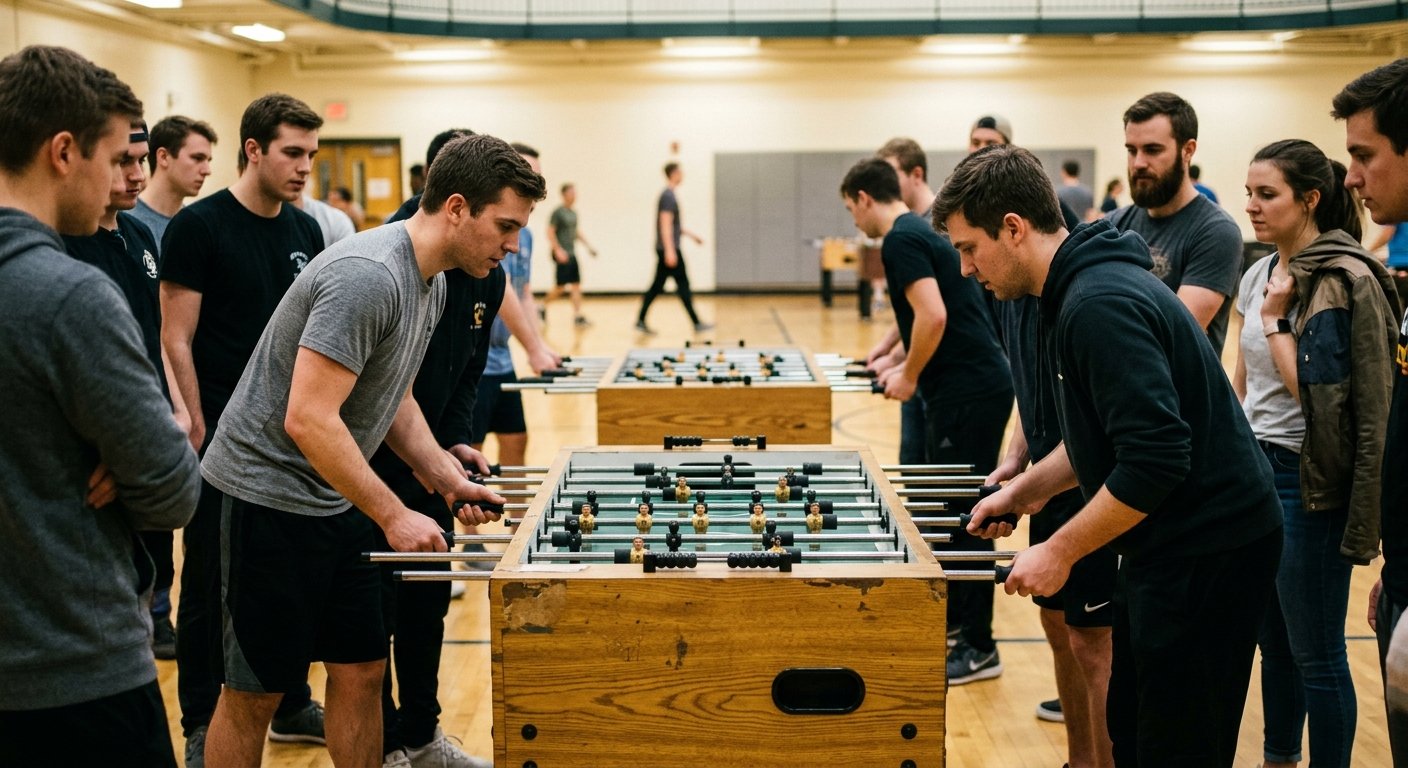
You can practice the pull shot (an open shot where the ball rests beside the 3-bar man’s foot, then the rod moves laterally and the man strikes in one fluid motion) for weeks in your garage and still be completely blindsided the first time someone runs a tight snake series at tournament speed. That’s not a knock — it’s just how the sport works. Competitive play compresses your learning curve faster than any solo drill session. One afternoon at a DYP event teaches you things that six months of casual play never will.
Beyond skill, there’s the community. Foosball players are, almost without exception, happy to talk shop, show you a grip adjustment, or explain why your 5-bar pass keeps getting picked off. The tournament table is where those conversations happen.
One afternoon at a DYP event teaches you things that six months of casual play never will.

Before you click “register” on anything, know what you’re signing up for. Here are the most common formats you’ll encounter at a first tournament:
The most beginner-friendly format on the circuit. You pay your entry, your name goes in a hat (literally or digitally), and you’re randomly paired with a doubles partner for each round. New partners every bracket, or sometimes the same pair runs double-elimination together — it varies by event. DYPs are social, fast-paced, and the lowest-pressure way to experience tournament foosball. If you’re asking yourself “where do I start?” — start here.
You recruit your own doubles partner ahead of time and register as a team. Better if you’ve been practicing with someone specific, but not the move for a first event unless you have a willing partner who already knows the game.
One player, one opponent, best of five games to five points. Pure skill. Great for competitive players; slightly brutal for a true first-timer because there’s nowhere to hide. Play a DYP first, then graduate to singles.
At a DYP, tell your partner upfront that it’s your first tournament. Good partners will call serves, choose sides, and communicate between points — it removes so much guesswork and lets you focus on actually playing.

If you’re in South Florida — Boca Raton, Fort Lauderdale, West Palm Beach, or Miami — you’re in luck. The region runs some of the most consistent weekly and monthly events in the state. Start with the Foos Central upcoming events page, which lists local DYPs, open events, and sanctioned tournaments. You can also submit a location or event through the site if you know of something we should be listing.
For broader national search, USA Foosball (USTSF) maintains a national calendar of sanctioned events. Their site is also where you’ll find the official rulebook, player rankings, and information on how tournament points are calculated. It’s the governing body for competitive foosball in the United States, and understanding their structure before you show up makes you look like you belong — because you do.
The International Table Soccer Federation (ITSF) governs the sport globally and is actively pursuing recognition for foosball at major international competitions. Not an Olympic sport. Yet. But the infrastructure for one is very much in place.
Check the Foos Central tournament calendar or USA Foosball’s national listings. Look for DYP or “open” in the event title — those welcome all skill levels.
Entry fees for local DYPs are typically paid at the door in cash. Larger sanctioned events may require advance registration — the how-to-register guide at Foos Central walks through both scenarios.
Review the basics before you go: 15-second possession limit per rod, 10 seconds on the 5-bar, two 30-second timeouts per game, games to five points. Check the rules page for the full rundown.
Registration usually opens 30–60 minutes before the first ball drops. Arrive early, get your name on the sheet, and take some warm-up time on a practice table if one’s available.
After each match, mentally log one thing that worked and one thing that didn’t. The debrief is half the value of entering tournaments in the first place.
Tournament tables in the US are almost universally Tornado tables — one-piece counterbalanced men, hollow steel rods, bearings, and the solid urethane ball you’ve probably seen at any serious foosball venue. If you’ve been practicing on a wobbly coin-op at a pizza place, the Tornado will feel noticeably tighter and faster. Get reps on one before the event if you can. The Foos Central Where to Play directory lists bars, game rooms, clubs, and leagues in South Florida where you can find a real table.
Key things that trip up first-timers:
USA Foosball tracks player points across sanctioned events. Your first event starts your ranking history. Even a first-round exit earns points. Over time, your accumulated foosball rankings score determines which divisions you qualify for at larger events — so every match counts, even the losses.
| Item | Bring it | Skip it |
|---|---|---|
| Cash for entry | Yes — most local events are cash at the door | |
| Your own ball | Tournament provides official balls; don’t swap in your own | |
| Comfortable shoes | Yes — you stand on hard floors for hours | |
| Silicone lube | Fine to bring; ask before applying to a venue table | |
| Attitude about the table | Leave the “this table is different” complaints home — same for everyone | |
| A notebook or notes app | Yes — log what you learn between rounds |
First-tournament nerves are real. Your hands will feel unfamiliar on rods you’ve gripped a hundred times. That’s not a flaw — it’s the competitive environment activating. The players who improve fastest aren’t the ones who feel no nerves; they’re the ones who keep shooting anyway.
A few things that genuinely help: breathe between points, not during the play. Reset your grip pressure after every score — most beginners white-knuckle the rod when they’re tight, which kills wrist speed on the pull shot. And talk to your DYP partner between games. Communication is half of doubles foosball.
If you lose early (and your first time, you might), stay and watch. Watch the 3-bar series the top players run. Watch how they set up the pull — ball at rest beside the man’s foot, lateral motion and strike all in one motion. Watch what the defense does to take it away. You’ll learn more watching two good players than you will reading about it.
Most local DYP events allow walk-in registration — show up, put your name and entry fee in, and you’re in the draw. Larger sanctioned events may require advance registration. Always check the specific event listing; the Foos Central how-to-register guide explains both processes step by step.
Open and DYP events have no minimum skill requirement. You do not need a USA Foosball ranking or any prior tournament experience. Beginners are genuinely welcome — most venues that run weekly events are actively trying to grow the player pool, and experienced players are usually happy to help newcomers learn the ropes between rounds.
USA Foosball (USTSF) assigns points based on your finish at sanctioned events. Points accumulate over time and determine your ranking and division eligibility at higher-level events. You can look up player standings at usafoosball.com. Your first sanctioned event starts your points history regardless of how far you advance.
A sanctioned event follows USA Foosball rules, uses approved equipment, and reports results to the national points system. An unsanctioned (or “fun”) event is typically a local bar or club night that plays by informal rules and doesn’t affect rankings. Both are worth playing — sanctioned events matter for your foosball rankings history; unsanctioned events are great for low-pressure reps.
The Foos Central upcoming events page lists current tournaments, weekly DYPs, and open events in Boca Raton, Fort Lauderdale, West Palm Beach, and Miami. You can also check USA Foosball’s national calendar for sanctioned events in the region.
Browse upcoming events in South Florida — or explore the Where to Play directory to find a table for practice before you go.
Grow the game
We put tournament-grade Tornado tables where kids can reach them. Bring the Youth Program to a school near you, or find a table and play tonight.