
Foosball Wall Pass vs. Brush Pass
The wall pass and the brush pass are the two fundamental ways to move the ball from your 5-bar (midfield rod) to your 3-bar…
The pull shot is the most reliable scoring weapon in competitive foosball.
The pull shot is the most reliable scoring weapon in competitive foosball. You set the ball at rest beside your middle 3-bar man’s foot, then move the rod laterally while striking in one fluid motion — no pinning, no hesitation. Mastered on a Tornado foosball table, a dialed-in pull shot gives you three distinct holes to attack and keeps defenders guessing on every possession.
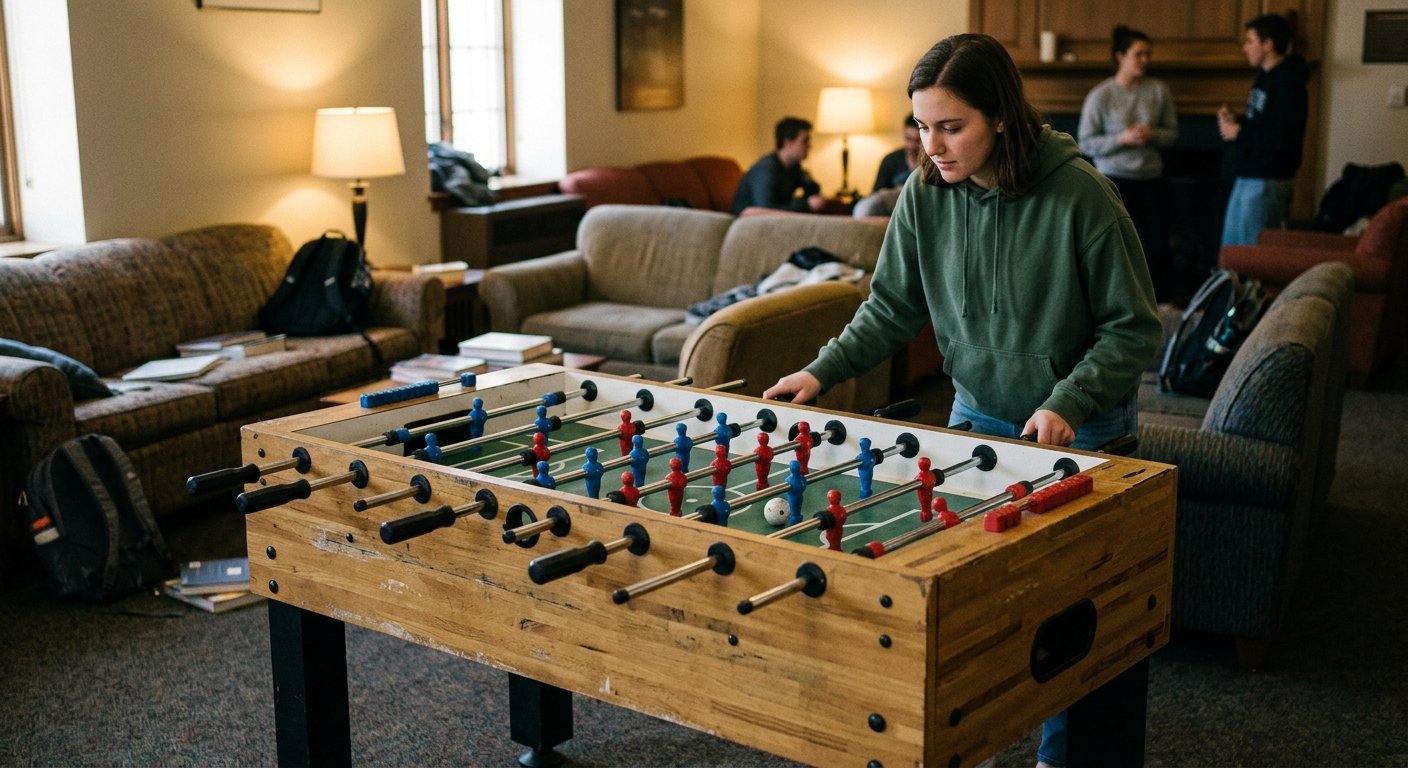
Before you can master anything, you need to know exactly what you’re working with. The pull shot is one of two foundational open shots in foosball — the push shot being the other — and both live on the 3-bar (your three-man offensive rod). “Open” means the ball is resting freely on the playfield beside the striking man’s foot. You are not holding it down, not pinning it, not trapping it. It simply sits there while you load up mentally and execute.
On a pull shot, you move the rod toward your body (pulling it) while your wrist simultaneously drives the man through the ball. The whole motion is one event. Players who learn it in two steps — slide, then kick — never develop the speed needed to beat a competent defender. Think of it less like a kick and more like a whip-crack: the lateral slide is the handle, the strike is the snap.
Under standard tournament rules — as codified by the International Table Soccer Federation (ITSF) — you have 15 seconds of possession on the 3-bar before the ball must be put in play. Use that time to read the defense and set up your shot, not to overthink it.
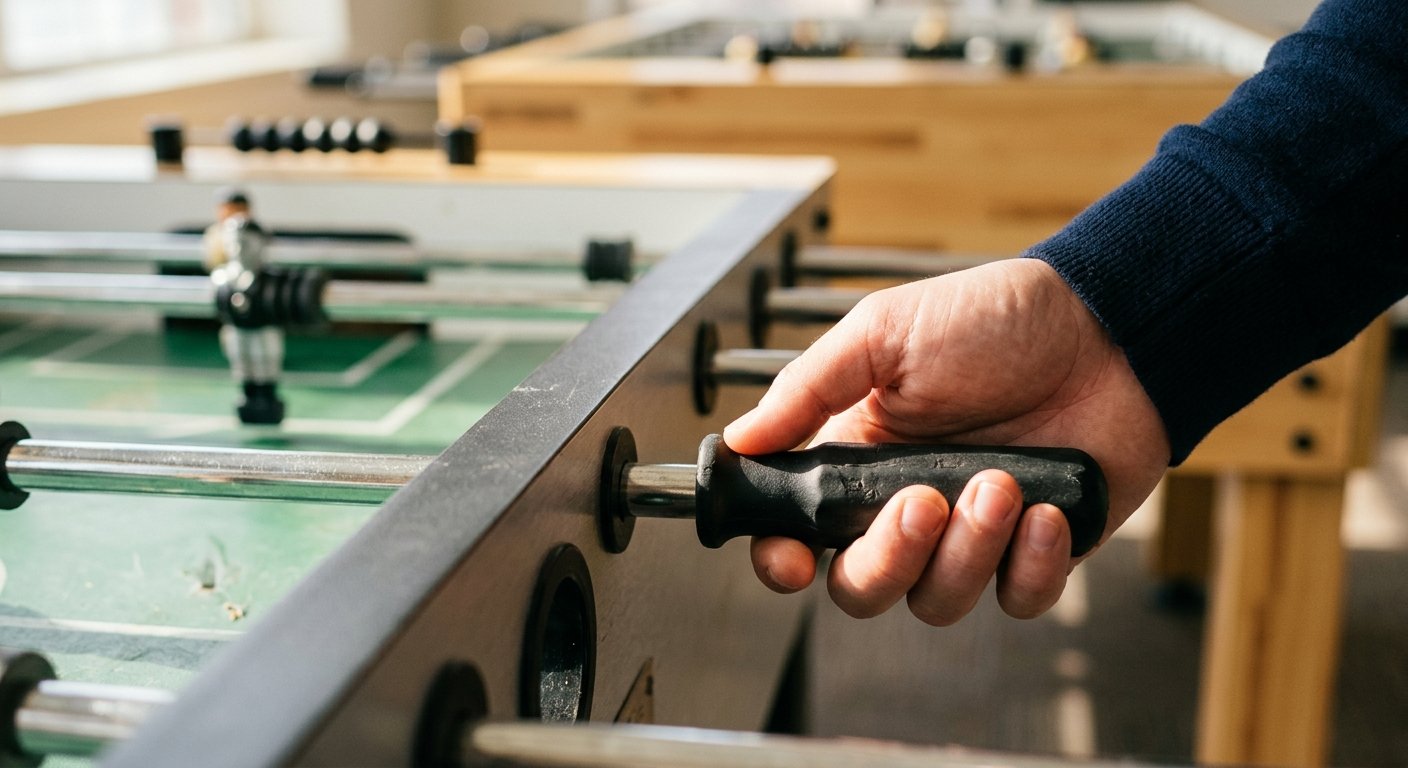
Wrap your shooting hand loosely around the handle — fingertips, not a death grip. A tight grip kills wrist speed, and wrist speed is everything here. The classic open-handed or “cradle” grip keeps your wrist loose and your forearm relaxed. Your non-shooting hand controls the 5-bar (midfield rod); keep it ready but relaxed while you’re in the shooting position.
Set the ball beside your middle 3-bar man’s foot, offset slightly toward the near wall. This gives you the full lateral travel — from near to far — without the ball rolling away before you’re ready. On a Tornado foosball table, the urethane ball grips the playfield well, so this positioning is reliable once you develop the muscle memory. Never let the ball drift under the man; that turns an open shot into a mess.
Stand square to the table, weight balanced. Your elbow should sit at roughly a 90-degree angle when your hand is on the handle. Too far away and you lose control; too close and you can’t generate the lateral movement you need. This isn’t yoga — adjust until it feels natural, then repeat it every single time you set up.
Before you practice any shots, spend five minutes just setting the ball to the same spot repeatedly. Inconsistent ball placement is the silent killer of otherwise decent pull shots. Same position every time means same shot every time.
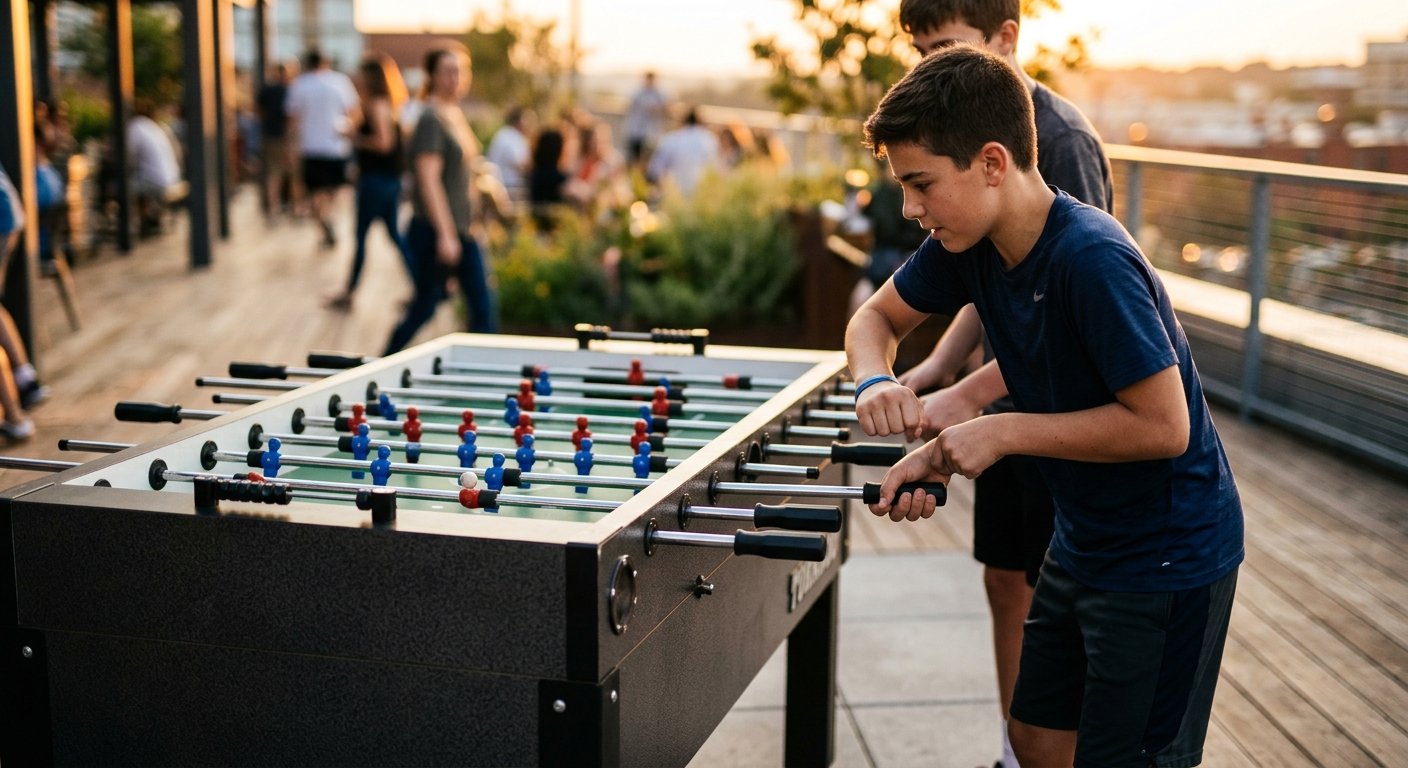
Ball is set. Eyes are on the defense, not the ball. Find your target hole — near, middle, or far post. Elite players read the defender’s weight distribution; a defender leaning toward the near wall is telling you something. Take your 15 seconds if you need them, but don’t waste them staring at the ceiling.
The motion starts with your shoulder and elbow pulling the rod toward your body. This is not a jerk — it’s a controlled, accelerating slide. As the rod begins to move, your wrist is already loading for the strike. The rod movement and wrist rotation are overlapping events, not sequential ones.
Your wrist snaps through the ball at the exact moment the man reaches the target lane. Aim to have the man strike the back half of the ball, driving it forward and low. Follow-through keeps the shot accurate; stopping your wrist mid-motion kills power and telegraphs hesitation to experienced defenders.
A pull shot to one hole is a guess. A pull shot series — hitting all three zones in rotation — is a strategy. Here’s how the three zones break down:
One hole is a guess. Three holes in a series is a strategy — and a good defender can’t be in three places at once.
| Attribute | Pull Shot | Push Shot |
|---|---|---|
| Rod direction | Toward body | Away from body |
| Ball position | Near wall side of middle man | Far wall side of middle man |
| Dominant scoring zone | Near and far post | Near and far post (mirrored) |
| Grip demand | Relaxed wrist, fast snap | Similar, but push-side wrist angle |
| Learning curve | Slightly more intuitive for right-handers | Requires deliberate practice for most |
Neither shot is “better.” Tournament players use both fluently, and defenders who’ve only seen your pull shot will eventually shade toward it. Mix both into your game and you’re operating at a different level. For deeper technique breakdowns, the Foos Central techniques library covers both in detail.
Reading about the pull shot and doing it are two very different things. Here’s a structured practice block you can actually use at the table:
If you want to see what good pull shot mechanics look like in motion, the Foos Central video library has technique footage worth studying between sessions. Watching and then immediately repping what you watched is one of the fastest ways to ingrain new mechanics.
The pull shot has been a staple of top-level play since the Tornado table became the US competitive standard — a status it’s held since the end of the Tournament Soccer professional tour era of the 1970s. USA Foosball (usafoosball.com) sanctions tournaments where pull-shot accuracy is often the difference between a bracket run and an early exit. If you want to test yours under pressure, competing is the fastest feedback loop available.
Here’s a truth that separates players from shooters: a defender who’s been watching you long enough will start to read your physical tells — the slight shoulder dip before you pull, the hesitation when you’re going far. Direction alone stops working. Timing variation is what keeps defenders honest.
Try these timing adjustments once your mechanics are solid:
Most players hit the same four walls before the pull shot clicks. Here’s how to skip them:
Yes. The pull shot is a fully legal open shot under both ITSF international rules and USA Foosball tournament rules. The ball rests freely beside the man — it is never pinned — so there are no spin or pin violations involved. It’s one of the most-used shots in competitive foosball worldwide.
With focused deliberate practice — not casual play, but structured drilling — most players develop a reasonably consistent single-hole pull shot within four to six weeks. Adding the full three-hole series with timing variation typically takes a few months of regular play. The mechanics are simple; the consistency takes repetition.
They’re completely different shots. The pull shot is open — the ball rests free beside the man’s foot and is struck in one lateral motion. The snake (also called the rollover) is a pinned shot — the ball is held under the front of the man’s foot and fired with a wrist rollover. The snake has a different setup, a different grip technique, and a different timing challenge.
You can work on grip mechanics and wrist speed off the table, but the pull shot requires actual table time to develop properly. Ball position, playfield feel, and defender reads are all table-specific. If you don’t have a table at home, the Foos Central Where to Play directory lists bars, game rooms, clubs and leagues across Boca Raton, Fort Lauderdale, West Palm Beach and Miami where you can get regular reps in.
Yes — start with the pull shot. It has a more intuitive setup, a lower wrist-speed threshold to start seeing results, and it teaches you the discipline of ball placement and reading defenders. The snake is a more advanced pinned shot with a longer learning curve. Build your open shots first; layer in the snake once your 3-bar fundamentals are solid.
Find a table near you, enter a local tournament, or bring the game to a school — Foos Central has all of it in one place.
Grow the game
We put tournament-grade Tornado tables where kids can reach them. Bring the Youth Program to a school near you, or find a table and play tonight.