
Foosball Wall Pass vs. Brush Pass
The wall pass and the brush pass are the two fundamental ways to move the ball from your 5-bar (midfield rod) to your 3-bar…
A DYP — Draw Your Partner — is a foosball tournament format where you show up solo and get randomly paired with a doubles partner for each round.
A DYP — Draw Your Partner — is a foosball tournament format where you show up solo and get randomly paired with a doubles partner for each round. You and your randomly drawn teammate play together, then the draw resets for the next round. It’s the most beginner-friendly, socially electric format in competitive foosball, and it’s where most players catch the tournament bug for the first time.
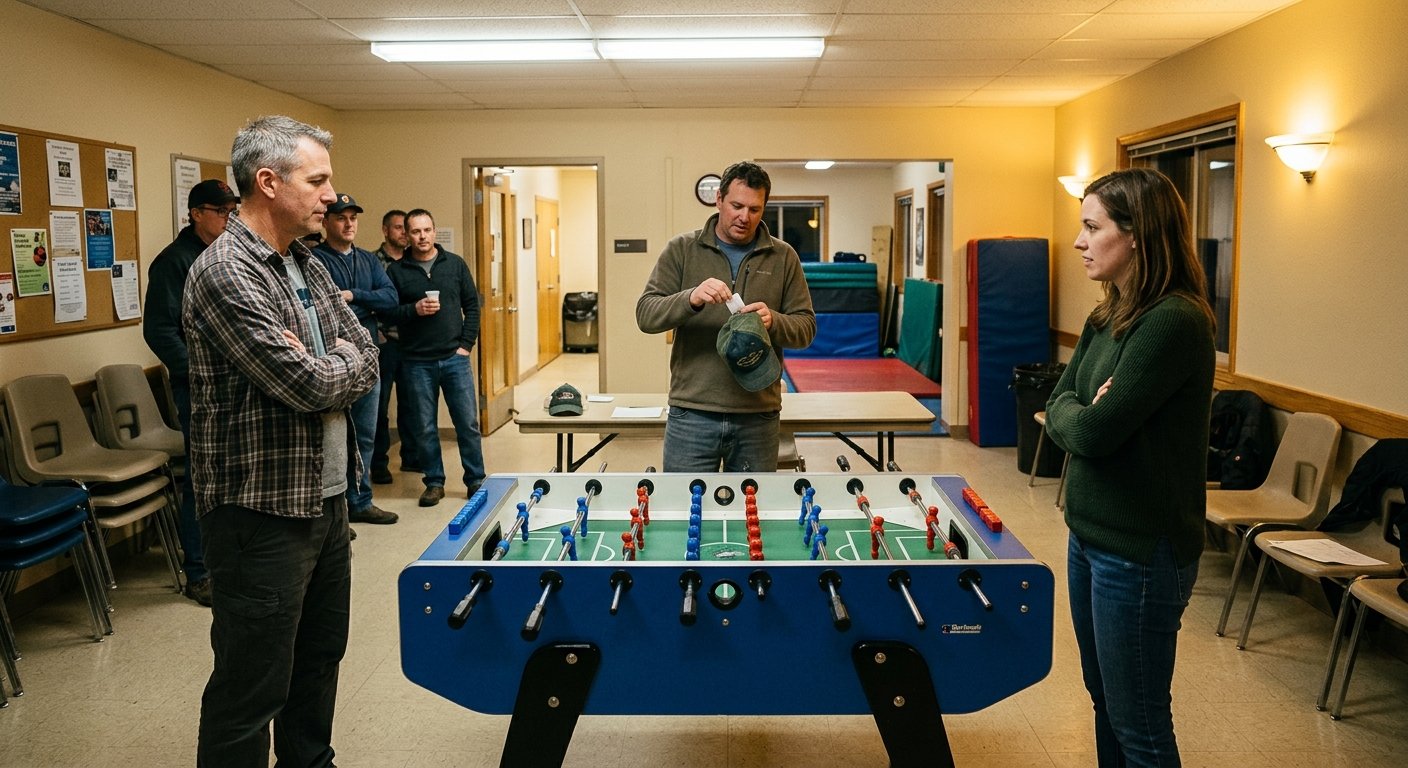
Before your first DYP, the phrase sounds almost too casual — like something from a square dance. In practice, it is one of the most thoughtful formats in competitive table soccer. Every round, the tournament director pulls names (or numbers) at random and pairs them into two-player teams. Those teams compete in a standard doubles format — two players per side, typically one on the 5-bar (midfield) and one on the 3-bar (offense) and 2-bar (defense goalie rod). When the round ends, the draw resets. You might play alongside a ranked master one round and a first-timer the next.
That randomness is the whole point. DYP rewards players who communicate well, adjust quickly, and cover for a partner’s weaknesses without ego. A strong 3-bar shooter who can’t set up their own shots will learn fast that a good 5-bar partner is worth their weight in gold.
If you’re new to doubles, default to the 5-bar. Feeding the ball cleanly into your partner’s 3-bar is a learnable skill, and it lets the more experienced player take the shots while you build confidence in your passing game.

The specifics can vary by venue and director, but here is the standard structure you’ll encounter at most Foos Central-listed tournaments and USTSF-affiliated events.
Players sign up individually. Many DYPs use a skill-based seeding system so that top-ranked players are distributed across the draw rather than paired together in round one. Check the event page before you show up — some events require pre-registration.
Names or numbers are pulled randomly (sometimes with seeding constraints). Your partner is announced. You have about two minutes to introduce yourself, decide who plays which rod, and get to the table.
Standard Tornado rules apply: games to 5 points, best-of-3 or best-of-5 depending on the event stage. You have 15 seconds of possession per rod (10 on the 5-bar), two 30-second timeouts per game, and all the usual rules — no spinning, no jarring, no reaching into the playfield.
At most sanctioned DYPs, each player earns individual points based on finish. Those points feed into the USTSF’s national ranking system. A BYP (Buy Your Partner) is a similar format where you pay to choose your partner — but DYP is the democratic version, and it’s the one that builds the most community.
Rounds continue — often pool play followed by a single or double-elimination bracket — until one team wins the event. Then the director announces the next draw, and it starts again if multiple events are running the same day.
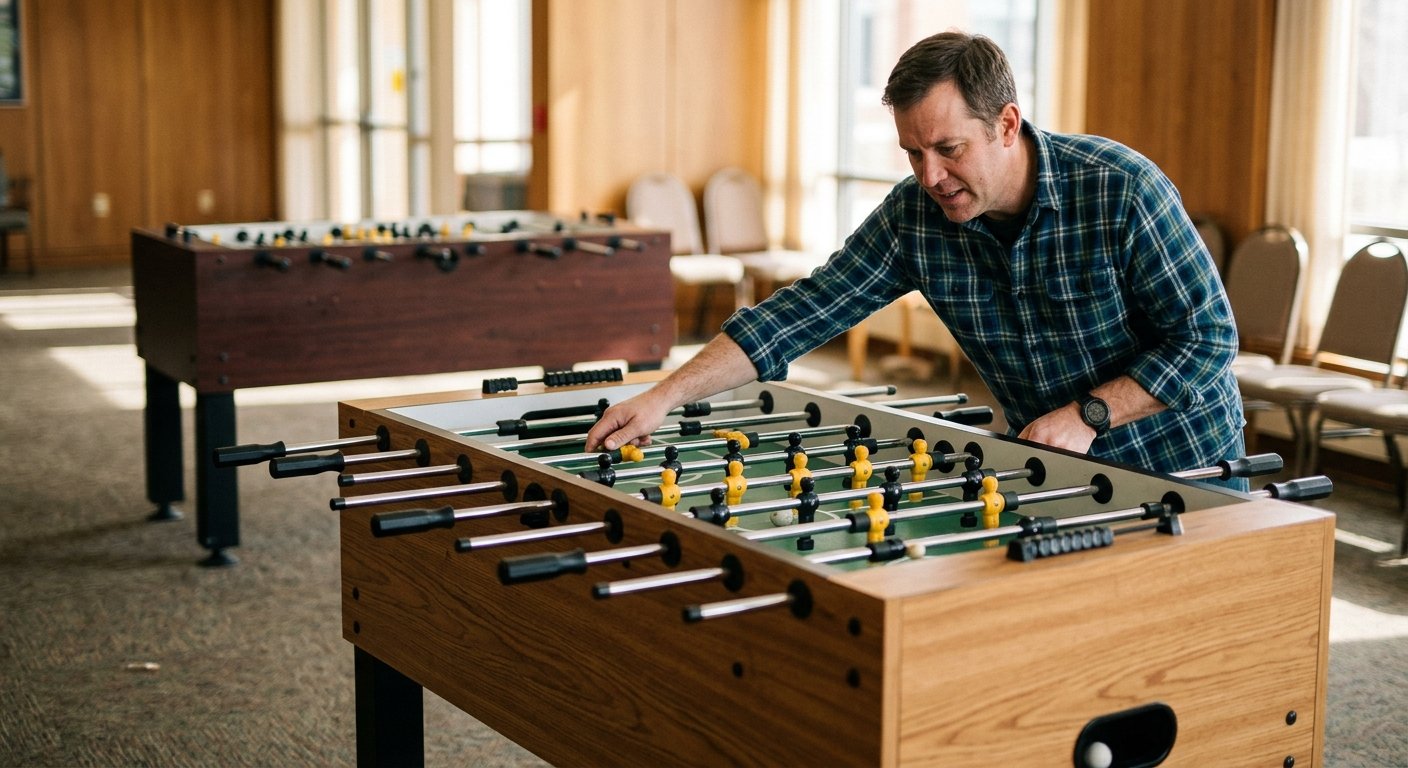
Foosball tournaments run in several formats. Understanding how DYP compares helps you choose where to start and where to aim next.
| Format | DYP | BYP | Open Singles |
|---|---|---|---|
| Partner selection | Random draw each round | You choose (and pay for) your partner | No partner — head to head |
| Entry requirement | Solo entry, any skill level | Solo entry; partner fee applies | Solo entry |
| Social factor | Very high — you meet everyone | Medium — you know your team | Low — pure competition |
| Points earned | Yes, USTSF-sanctioned events | Yes | Yes |
| Best for beginners | Yes — ideal first event | Better with a known partner | Can be intense without match experience |
Here’s where DYP gets serious fast. USA Foosball (USTSF), the national governing body for table soccer in the United States, runs a national ranking system. Points earned at sanctioned events — including DYPs — accumulate over a rolling period and determine your ranking class. Classes range from Rookie and Novice up through Amateur, Expert, and Master. Your class determines which events you’re eligible to enter at nationals, and it follows you.
That means a DYP at a South Florida bar isn’t just a fun Thursday night. It’s a point-earning opportunity. Win or place well enough times and your ranking class rises. That’s the hook. Players who start at a casual weekly DYP find themselves checking the points lookup tool obsessively within a few months.
A DYP at a South Florida bar isn’t just a fun Thursday night. It’s a point-earning opportunity — and the hook that turns casual players into competitors.
The International Table Soccer Federation (ITSF), the global body that oversees competitive foosball worldwide and pursues Olympic recognition for the sport (not yet achieved, but the effort is real and ongoing), also recognizes ranking-based competition structures. As foosball continues to grow internationally, the DYP format and its individual-points structure translate well into the global competitive ecosystem.
The obvious appeal for newcomers: you don’t need to know anyone, you don’t need a regular partner, and you’re not locked into a team that could embarrass you if you have an off night. You show up, you draw, you play. Worst case, you learn something. Best case, you make a connection with a player who teaches you something you’ll use for years.
For experienced players, the challenge is real in a different direction. Adapting your game to an unfamiliar partner — quickly — is a genuine skill. Can you read how they pass? Do they shoot the pull shot or the snake? Are they going to catch the ball on the 5-bar or push it immediately? A 3-bar player who’s used to feeding off a specific partner has to rebuild that chemistry in about two minutes of warmup. That’s a legitimate test of foosball IQ.
On a standard Tornado table, each team has 13 men across four rods: the 3-man goalie rod, the 2-man defense rod, the 5-man midfield rod, and the 3-man forward rod. In doubles, players split those rods — typically one person handles the 5-bar and goalie, the other handles the 3-bar and 2-bar. Communicating that split before the match starts saves a lot of confusion mid-game.
You don’t need to be good to enter. You need to know the basics so you don’t slow the event down or frustrate your partners.
South Florida has one of the more active regional foosball communities in the country. Weekly DYPs run at bars, game rooms, and clubs across Broward, Palm Beach, and Miami-Dade counties. The Foos Central Where to Play directory lists verified venues with tables worth playing on — none of that wobbly-rod, dead-ball, coin-op-in-a-corner stuff. If you know of a venue running events that isn’t listed, you can submit an event directly to the site.
It’s also worth noting: if you’re a parent, coach, or school administrator reading this because a kid got interested in the sport — Foos Central’s Youth Program places tournament-grade Tornado tables in South Florida schools. Real tables, real rules, real competitive foundation. DYP-format events are a natural next step for students who come up through that program.
No — that’s the whole point. DYP stands for Draw Your Partner, meaning you register solo and get randomly paired with a doubles partner at the start of each round. You don’t need to know anyone ahead of time, which makes it the most accessible foosball tournament format for beginners and solo players.
Yes, at sanctioned events they do. USA Foosball (USTSF) runs a national points and ranking system; players earn individual points based on their finish in each sanctioned DYP. Those points accumulate and determine your ranking class — from Rookie through Master — which affects your eligibility at higher-level events.
In a DYP (Draw Your Partner) your partner is chosen randomly each round. In a BYP (Buy Your Partner) you pay an additional entry fee to select a specific partner for the entire event. DYP is generally more beginner-friendly and socially oriented; BYP suits established playing partnerships. Both formats award individual ranking points at sanctioned events.
It depends on the number of entrants and how many events are running simultaneously. A casual weekly DYP at a bar with 12–20 players might wrap in two to three hours. A larger multi-event tournament day can run six hours or more. Check the event listing for a projected schedule before you go.
Any level. Most DYPs are open entry and use a draw or seeding system to prevent the strongest players from being paired together every round, which keeps the field competitive and fun for everyone. Beginners are genuinely welcome — just know the basic rules (legal serves, possession clock, no spinning) so the event runs smoothly for your partners too.
Browse upcoming tournaments, find a venue near you, and check the how-to-register guide — everything you need to go from curious to competing is at Foos Central.
Grow the game
We put tournament-grade Tornado tables where kids can reach them. Bring the Youth Program to a school near you, or find a table and play tonight.