
Foosball Wall Pass vs. Brush Pass
The wall pass and the brush pass are the two fundamental ways to move the ball from your 5-bar (midfield rod) to your 3-bar…
Foosball has been spinning rods, settling arguments, and building communities for nearly a century — and the story of how a simple ...
Foosball has been spinning rods, settling arguments, and building communities for nearly a century — and the story of how a simple table game became a legitimate competitive sport is way more dramatic than most people realize.

Ask ten foosball players who invented the game and you’ll get three different answers and one person who insists they don’t care as long as the table is level. The honest answer: the origin of foosball is genuinely disputed, and multiple countries have credible claims.
The most widely cited patent belongs to Harold Searles Thornton, a British inventor who filed a patent in the United Kingdom in 1921 for a table-top football game with rotating rods and player figures. That patent is real and documented. However, advocates in France, Germany, Spain, and Switzerland have all pointed to early versions of the game developed independently around the same era — the 1920s through the 1940s — as soccer’s popularity exploded across Europe after World War I.
The Spanish claim centers on Alejandro Finisterre, who is widely reported to have built an early foosball table in the late 1930s to entertain children injured during the Spanish Civil War. His story is compelling and frequently repeated, though the documentary record is thin. What’s clear is that by the 1950s, foosball tables had spread across European cafés, bars, and youth centers under a dozen different names: baby-foot in France, kicker in Germany, calciobalilla in Italy.
The word “foosball” comes from the German “Fußball,” meaning football (soccer). American GIs stationed in Germany after World War II encountered the game there and brought the concept — and eventually the name — back to the United States.
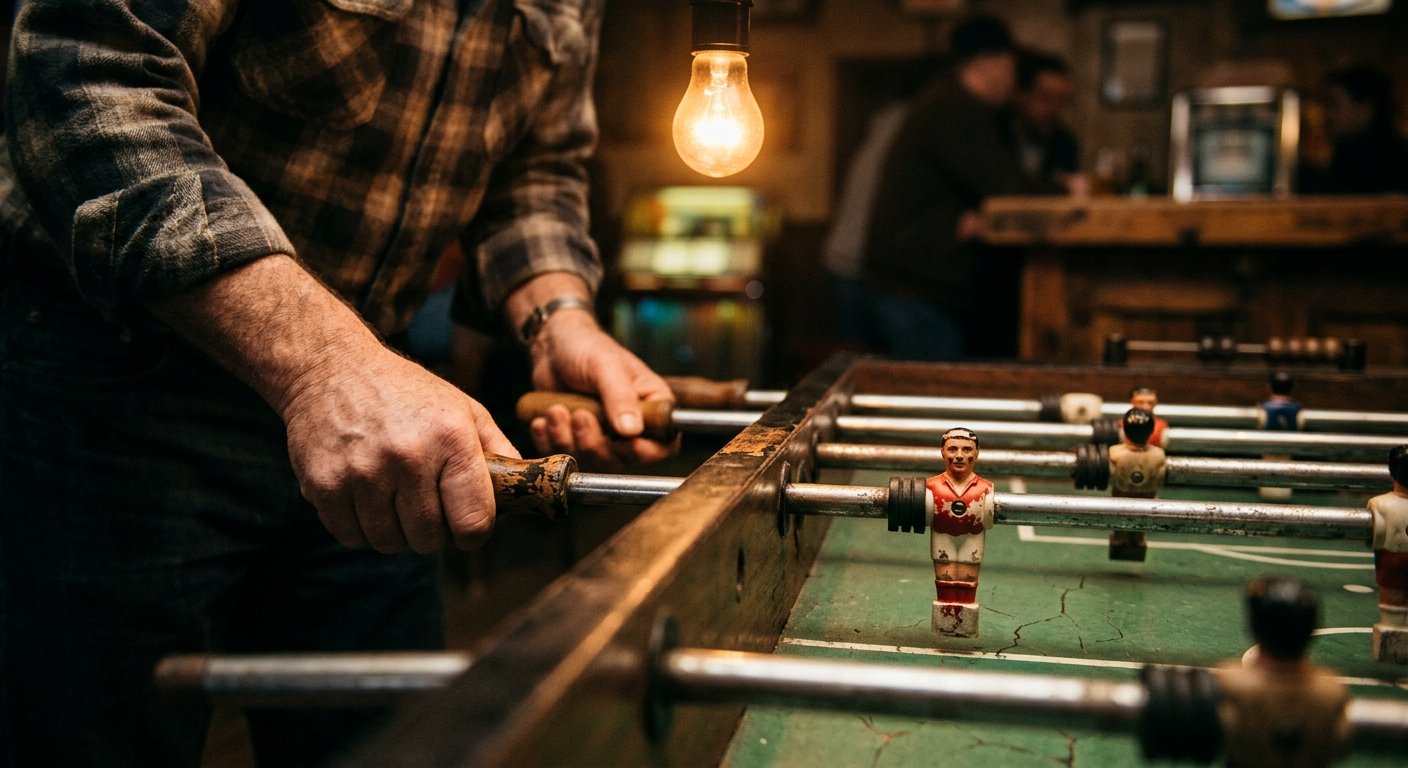
The American foosball story begins in earnest in the late 1950s and 1960s, when domestic manufacturers started producing tables for bars, bowling alleys, and rec rooms. Early US tables were inconsistent — rods wobbled, men cracked, and the balls were as predictable as a coin flip. But the game spread anyway, fueled by the same social energy that was filling pool halls and bowling alleys across the country.
The company that changed everything was Valley-Dynamo, based in Texas. In the early 1970s, they introduced the Tornado table — a machine built to a different standard. The Tornado featured a telescoping rod system (later a key safety feature), a solid playing surface, and a consistent ball that rewarded skill over luck. Competitive players immediately recognized the difference. You can learn more about the Tornado’s specs and why it remains the US competitive standard at tornadofoosball.com.
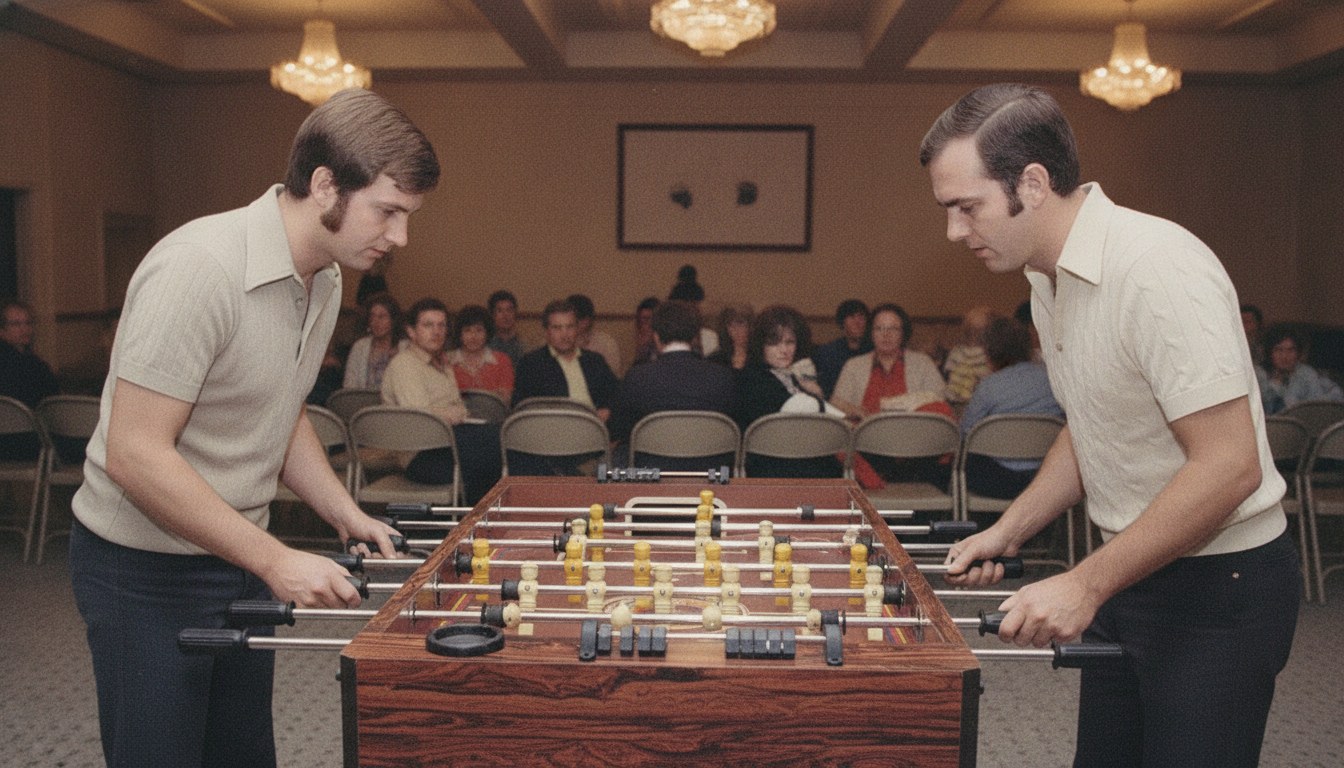
Here’s the part of foosball history that even most players don’t know well enough: for a few years in the mid-to-late 1970s, foosball was enormous in America. Not “popular bar game” enormous — genuinely televised, professionally contested, serious-prize-money enormous.
The company behind it was Tournament Soccer, a Seattle-based manufacturer founded by Lee Peppard. Tournament Soccer built its own tables and then built a professional circuit around them: by the late 1970s the tour was widely reported to be paying out on the order of a million dollars a year in prize money, which is where the “Million Dollar” name comes from. The tables carried the tour’s emblem — the rainbow-ringed Tournament Soccer “Million Dollar Game” logo — and that badge became one of the most recognizable marks in the sport. Longtime players still call the era’s tables “TS tables,” and the logo shows up on shirts, posters and restored cabinets to this day.
If you see a brown cabinet with a rainbow ring, a player figure and the words “Million Dollar Game” on the side, you are looking at a Tournament Soccer table from the tour years — the closest thing foosball has to a vintage-guitar collectible.
For a few years in the 1970s, foosball was the fastest-growing competitive sport in America — and then, almost as fast, it wasn’t.
The Million Dollar Tour was a circuit of high-stakes foosball tournaments that drew crowds, cameras, and players willing to travel across the country to compete. Prize money at individual events ran into the thousands of dollars — significant money at the time. Manufacturers sponsored the events, bars installed tables by the dozen, and foosball briefly occupied the same cultural space that poker tournaments and pool competitions do today.
The legends of that era — players whose names still circulate at competitive tables — developed the foundational techniques that define the game today: the pull shot (pulling the 3-bar rod toward you before striking), the push shot (its mirror image), and the early versions of the snake (also called the rollover or wrist shot), where the ball is pinned and then struck with a fast wrist roll rather than a straight pull or push. These shots didn’t have standardized names yet, but the mechanics were being discovered and refined in real time.
By the early 1980s, the Million Dollar Tour had collapsed. Video games — Pac-Man, Space Invaders, Donkey Kong — were eating up the floor space in bars and arcades that foosball tables had occupied. Manufacturers pulled back. Sponsorships dried up. The professional circuit essentially vanished.
What saved the game was the players themselves. Competitive foosball didn’t disappear — it went underground, sustained by local clubs, basement games, and the kind of obsessive players who will drive two hours for a good table. Regional associations formed. Rules got standardized. The game became more serious, if less visible.
Harold Thornton files a UK patent for a table football game, the earliest widely accepted documentation of the concept.
Domestic manufacturers begin producing tables for bars and rec rooms; the game spreads through bowling alleys and college campuses.
Valley-Dynamo’s Tornado table raises the competitive standard; the Million Dollar Tour brings professional foosball to national attention.
Video games displace foosball from bars; competitive players keep the game alive through clubs and regional events.
The International Table Soccer Federation is established, creating global governance, standardized rules, and a pathway toward Olympic recognition.
The modern era of competitive foosball traces back to 2002 with the founding of the International Table Soccer Federation (ITSF). Based in France, the ITSF created a framework that the sport had never had before: standardized international rules, a ranking system, licensed equipment lists for sanctioned tournaments, and a genuine organizational structure capable of interfacing with bodies like the International Olympic Committee.
According to the ITSF’s official site, the federation now includes member associations from over 60 countries. World championships are held annually, drawing players from across Europe, the Americas, Asia, and Africa. The ITSF has pursued and achieved recognition from SportAccord (the umbrella body for international sports federations) — a meaningful step on the long road toward Olympic consideration.
Is foosball an Olympic sport? Not yet. The IOC’s criteria for new sports include global participation, anti-doping compliance, and demonstrated spectator appeal — boxes the ITSF is actively working to check. The sport’s advocates point to table tennis and badminton as precedents: precision skill sports that earned Olympic status after decades of organized international competition. The trajectory is there. The timeline is uncertain. (Not an Olympic sport. Yet.)
In the United States, USA Foosball / USTSF serves as the national governing body, sanctioning tournaments and maintaining player rankings. Their site at usafoosball.com tracks points, upcoming events, and the ranking system that competitive players use to seed themselves in events like the DYP (draw your partner, a format where partners are randomly assigned) and BYP (bring your partner) doubles tournaments.
| Era | Defining feature | Primary venue |
|---|---|---|
| 1920s–1940s | European origins, café culture | Bars and youth centers (Europe) |
| 1960s–1970s | US expansion and Million Dollar Tour | Bars, bowling alleys, arcades |
| 1980s–1990s | Underground competitive survival | Clubs and private homes |
| 2000s–present | ITSF governance, global growth | Dedicated game rooms, schools, clubs |
You can’t tell the history of competitive foosball in America without telling the history of the Tornado table. Valley-Dynamo built a machine that created a level playing field — literally and figuratively. The consistent ball bounce, the rod tension, the goalie configuration with three men (rather than the one-goalie setup on some European-standard tables): all of these features shaped how American players approach the game.
The Tornado is still the standard for US sanctioned tournament play. When you walk into a serious competitive room — whether it’s a club in Fort Lauderdale or a tournament venue in Miami — you’ll find Tornado tables. When the Foos Central Youth Program places tournament-grade equipment in South Florida schools, those are Tornado tables, because giving young players access to the right equipment from the start matters. A kid who learns on a quality table learns the real game.
If you want to develop real competitive skills, find a Tornado table to practice on. The rod tension, ball speed, and playing surface on recreational tables are different enough that habits built on inferior equipment can actually work against you when you step into a sanctioned event. Check the Foos Central Where to Play directory to find quality tables near you in South Florida.
In 2026, foosball is in a genuinely interesting moment. The competitive infrastructure is stronger than it’s been since the 1970s: the ITSF runs World Championships, USA Foosball maintains national rankings, and local leagues are active from Boca Raton to Miami. Streaming and social media have given competitive foosball a visibility it lacked during the underground decades — you can watch elite players break down the mechanics of a snake shot on video in ways that would have required a road trip and a knowledgeable mentor in 1985.
Youth programs are a real growth driver. Getting tournament-grade Tornado tables into schools — like what Foos Central’s Youth Program is doing in South Florida — introduces the game to players who might never wander into a competitive bar room on their own. Those players grow up, enter tournaments, start clubs, and keep the ecosystem alive.
The Million Dollar Tour is gone, but what it proved — that foosball can be a spectator sport, that elite-level play is genuinely exciting to watch, that the game rewards years of serious practice — that’s still true. The sport’s history is one of cycles: boom, crash, underground, rebuild. Right now, it’s rebuilding into something more durable than the 1970s wave because the organizational structure is actually there this time.
The most documented early patent belongs to British inventor Harold Searles Thornton, who filed in 1921. However, multiple countries — including Spain, France, and Germany — have credible independent claims to early versions of the game developed around the same era. The honest answer is that the invention was likely parallel rather than singular, driven by the spread of soccer across post-WWI Europe.
The Million Dollar Tour was a professional foosball competition circuit that ran primarily in the mid-to-late 1970s in the United States. It featured significant prize money for the era, manufacturer sponsorships, and drew serious competitive players from across the country. The tour effectively collapsed in the early 1980s as video games displaced foosball from bars and arcades.
Yes — the International Table Soccer Federation (ITSF) governs foosball globally and is recognized by SportAccord, the umbrella body for international sports federations. Foosball is not currently an Olympic sport, but the ITSF has been actively pursuing the criteria required for Olympic consideration, including global participation and anti-doping compliance.
The Tornado table, manufactured by Valley-Dynamo, became the US competitive standard in the 1970s due to its consistent playing surface, ball behavior, and rod construction. USA Foosball sanctions tournaments on Tornado tables, meaning players who develop their skills on a Tornado are training on the actual equipment they’ll encounter in competition.
Foos Central maintains a Where to Play directory covering bars, game rooms, clubs, and leagues across Boca Raton, Fort Lauderdale, West Palm Beach, and Miami. Visit fooscentral.com/where-to-play/ for current listings, including venues with Tornado tables and active weekly events.
Whether you’re tracing your love of foosball back to a dusty bar table or stepping into your first tournament, Foos Central is your home base in South Florida — rooms, events, results, and a Youth Program putting real tables in schools.
Grow the game
We put tournament-grade Tornado tables where kids can reach them. Bring the Youth Program to a school near you, or find a table and play tonight.