Foosball Wall Pass vs. Brush Pass
The wall pass and the brush pass are the two fundamental ways to move the ball from your 5-bar (midfield rod) to your 3-bar…
If you're serious about foosball — or want to become serious — the table you play on matters enormously, and the Tornado T-3000 is the starting point for...
If you’re serious about foosball — or want to become serious — the table you play on matters enormously, and the Tornado T-3000 is the starting point for almost every honest conversation about buying a competitive foosball table for home or venue use.
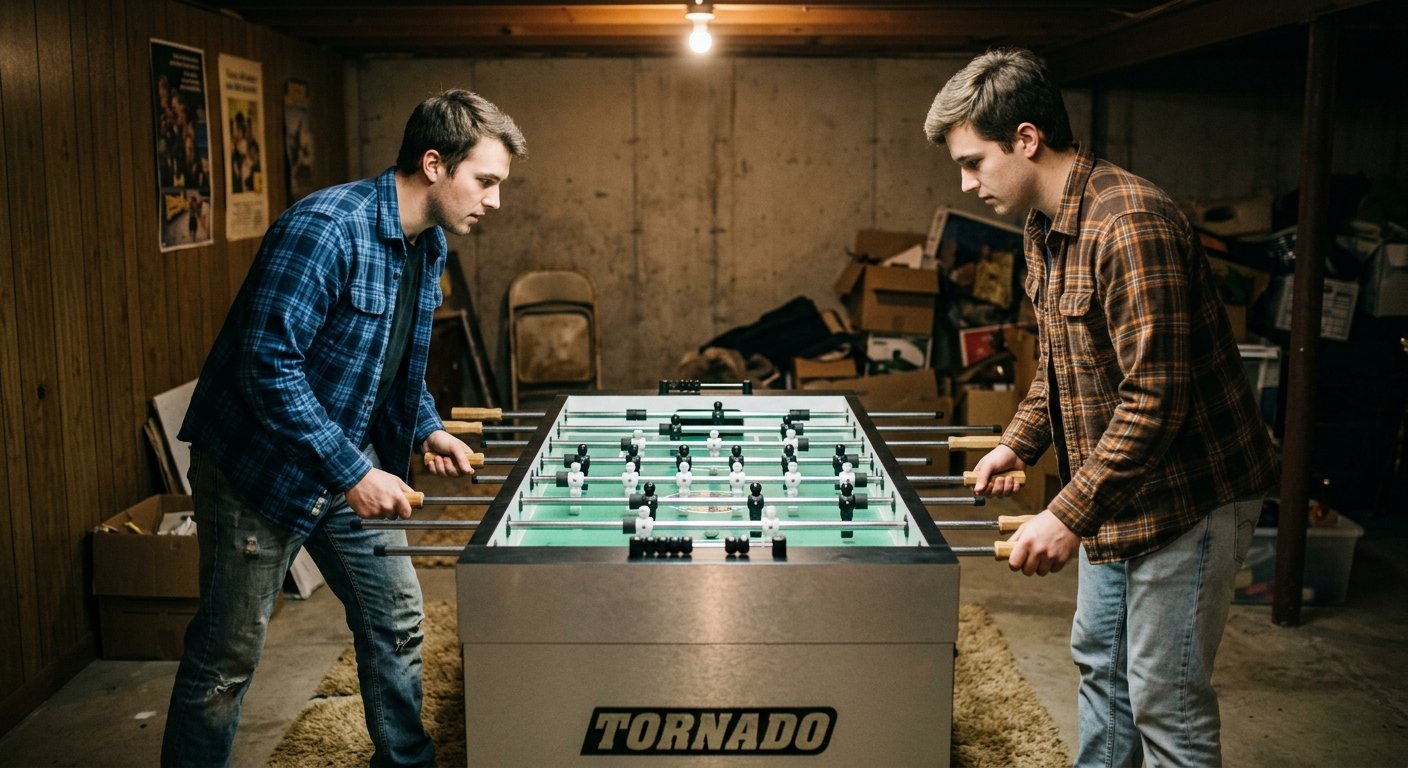
After the Tournament Soccer professional era wound down in the late 1970s and early 1980s — that’s the “Million Dollar” era, where the Seattle-based tour run by Lee Peppard reportedly paid out roughly a million dollars a year in prize money at its peak — Tornado (manufactured by Valley-Dynamo, now operating as Tornado Foosball) became the de facto competitive table in the United States. That wasn’t marketing; it was earned through durability, consistency, and the loyalty of serious players who needed a table they could count on game after game, year after year.
Today, USA Foosball / USTSF sanctions events on Tornado tables, and the ITSF — the International Table Soccer Federation, which governs the sport globally and actively pursues Olympic recognition (not an official Olympic sport yet, but working on it) — recognizes Tornado as one of its certified table brands. If you’re training for US competition, practicing on a Tornado isn’t optional. It’s just what you do.
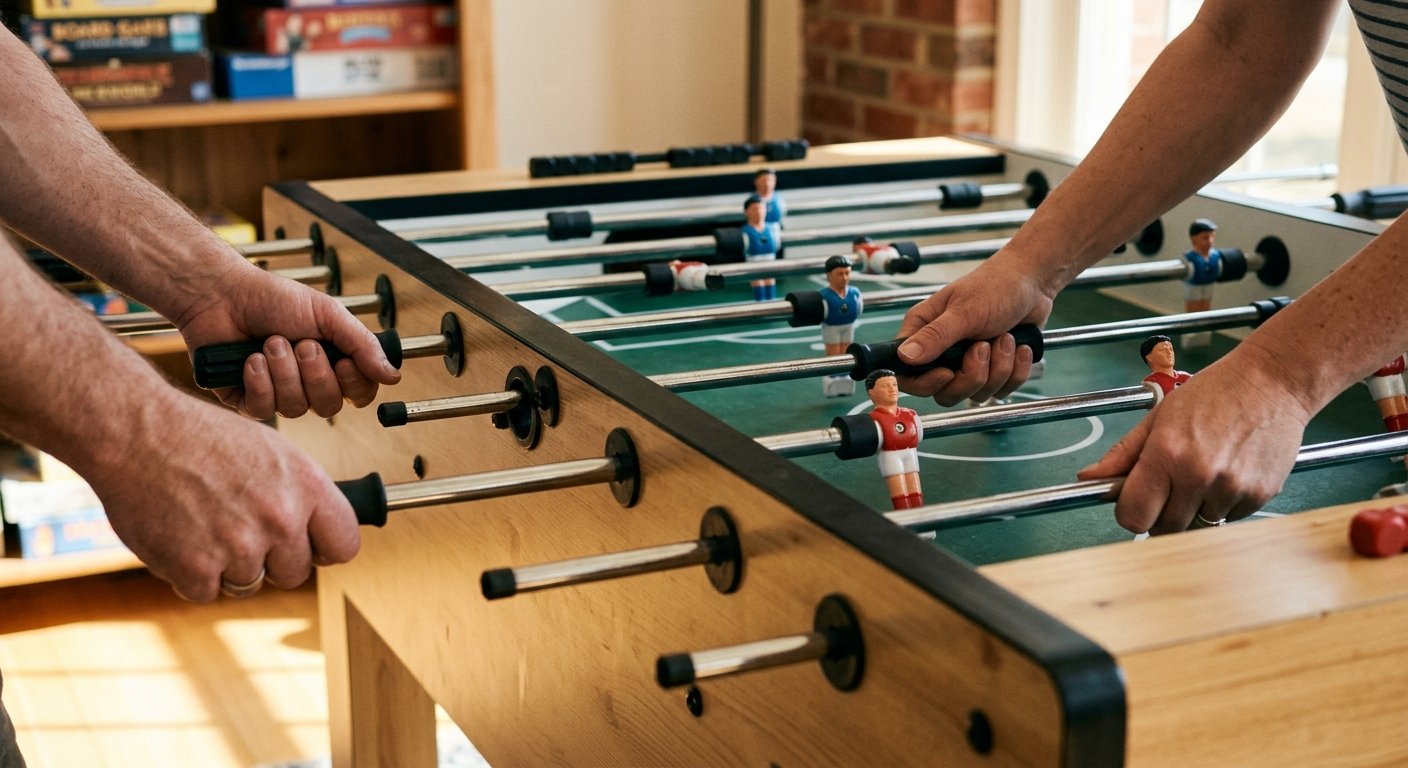
The T-3000 is Tornado’s residential flagship — tournament DNA in a package designed for home game rooms, school common areas, and serious bar installations. Here’s what separates it from the sub-$500 tables crowding online marketplaces.
Budget tables use telescoping rods (hollow, with a smaller rod that slides inside) because they’re safer without end caps and cheaper to produce. The T-3000 uses solid steel rods — the same type used on tournament tables. Solid rods are stiffer, faster, and far more consistent. If you’re drilling your pull shot (a lateral rod slide that redirects the ball from one side to the other) or your snake/rollover (a wrist-rotation shot using the 3-bar, also called the 3-man rod), you need solid rods to build muscle memory that transfers to competition.
The T-3000 uses Tornado’s standard bearing system, which gives each rod a smooth, consistent slide with minimal slop — that tiny unwanted wobble that throws off your timing on a pin shot (where you trap the ball against the playfield with a man before shooting). Fast bearings reward technique; forgiving bearings hide bad habits. You want fast bearings.
The playfield is a hard laminate with clearly marked lines and a surface that produces true ball roll. Tornado uses its own textured ball — lighter and faster than the rubber balls that come with recreational tables. The ball matters more than most buyers realize. A Tornado ball behaves differently enough from a generic ball that switching mid-training will scramble your spray shot (angling the ball to a specific corner) timing noticeably.
Order a two-pack of official Tornado balls when you buy the table. They wear down over months of heavy play, and having a fresh one ready means you’re never adjusting your game to a degraded ball.
The T-3000 cabinet is heavy — intentionally so. Weight equals stability; a table that rocks when you fire your 5-bar (the five-man passing rod) pass kills consistency. The legs are adjustable for leveling on imperfect floors. Level the table the day it arrives. Check it monthly. A tilted table creates a ball that drifts, and a drifting ball is the enemy of every repeatable shot series (a pre-planned sequence of shot options used to beat a locked defender).
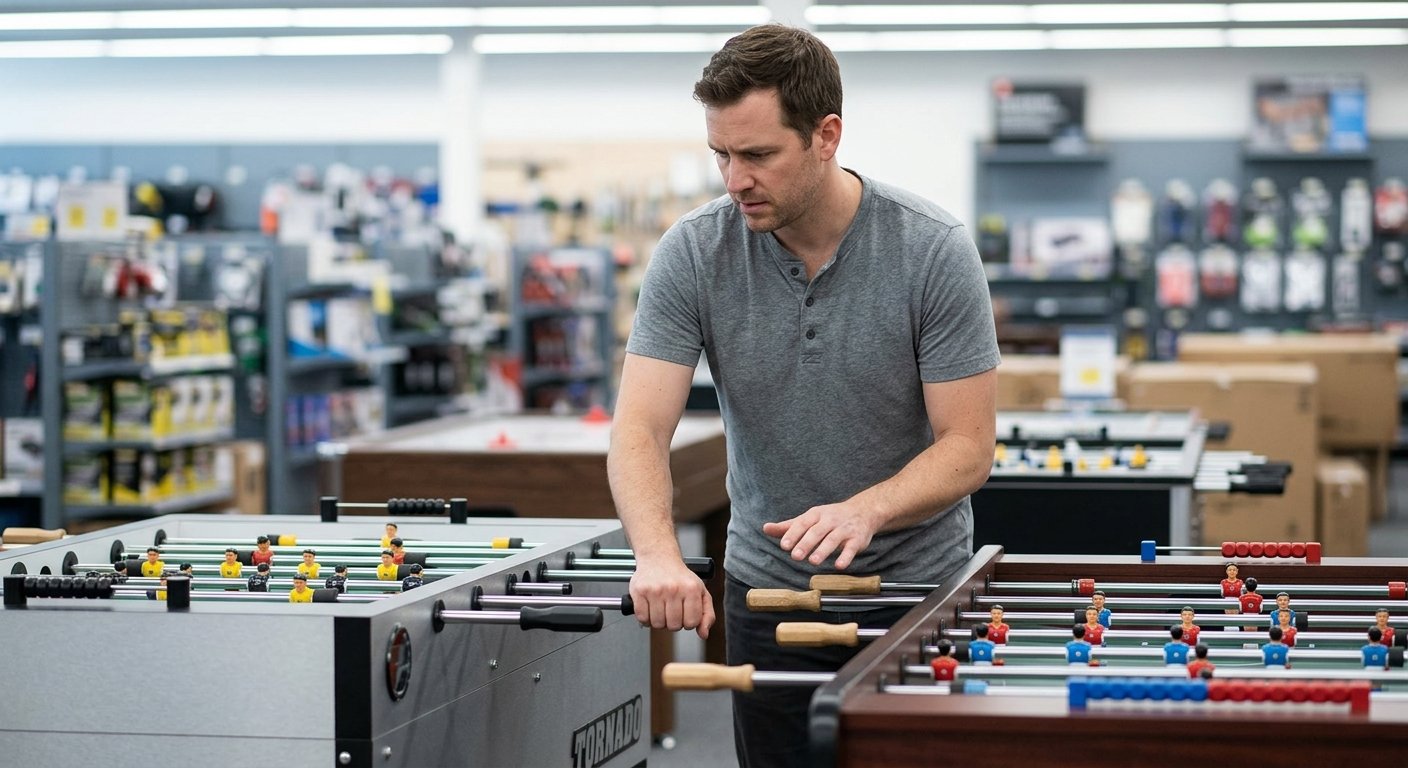
Two names come up constantly when buyers compare Tornado to European tables: Garlando and Bonzini. Both are legitimate, quality tables with strong competitive scenes outside the United States. Here’s the honest breakdown.
| Criterion | Tornado T-3000 | Garlando (G-500 / Pro) | Bonzini B90 |
|---|---|---|---|
| Rod type | Solid steel | Solid steel | Solid steel |
| Man style | Flat-footed, heavier | Contoured foot | Round-toe, lighter |
| Ball type | Textured hard ball | Textured hard ball | Cork ball (distinctive) |
| Goalie configuration | 3-goalie | 1-goalie | 1-goalie |
| US tournament use | Standard | Rare | Rare (ITSF-sanctioned internationally) |
| Best for | US competitive play and training | European-style recreational/competitive | European-style competitive, ITSF events abroad |
The goalie configuration difference is significant. Tornado uses a 3-goalie setup (three men on the goalie rod); most European tables use a single goalie. The defensive angles, blocking technique, and positioning are completely different between the two systems. If you’re planning to play in US events, train on the 3-goalie setup. If you’re heading to European ITSF events, the Bonzini or Garlando will feel more familiar. Most US players making the jump to international play report a real adjustment period — it’s not just cultural.
Train on the table you’ll compete on. Everything else is trivia.
Tornado produces several table variants. The T-3000 sits between entry-level recreational builds and full coin-operated commercial units. Here’s the quick orientation:
The Sport models use telescoping rods and lighter cabinets. They’re fine for kids learning the basics or casual family play, but they won’t hold up to serious training and they won’t transfer your skills to a tournament table. The T-3000 is the lowest rung where you’re genuinely playing the same game you’ll find at a sanctioned event. The full Tournament and Pro models add heavier cabinets, upgraded bearings, and in some configurations coin mechanisms — they’re the tables you’ll find at venues in our Where to Play directory.
Home game room for one serious player? Family table that also handles competitive training? Venue or school installation? The T-3000 covers all three, but a venue with heavy daily traffic should look at the commercial coin-op models for longevity.
A full-size Tornado table needs about 8 feet of clearance end-to-end (rod extension included) and 5 feet side-to-side for comfortable play. Don’t order until you’ve taped out the footprint on your floor.
Tornado tables purchased through unauthorized channels may void warranty coverage. Check the Tornado Foosball website for current authorized dealers. Freight shipping is typically included on new tables, but inspect for damage before signing.
Extra balls, Tornado silicone lubricant for the rods, and a quality brush for playfield cleaning. These add up to under $50 and extend table life significantly.
Use an actual bubble level — not your eye — and adjust the leg levelers until the playfield is true. Put a ball in the center and watch for drift. If it moves, keep adjusting.
One thing worth naming directly: a tournament-grade Tornado table in a school environment isn’t a wild idea. It’s exactly what Foos Central’s Youth Program is doing right now in South Florida — placing real Tornado tables in schools so students can learn the actual game, not a watered-down approximation of it. Kids who train on proper tables develop hand-eye coordination, spatial reasoning, and the competitive focus that transfers to every other skill sport. If you’re a coach, administrator, or parent in Boca Raton, Fort Lauderdale, West Palm Beach, or Miami who wants to explore bringing a table to your school, the Youth Program page is your next click.
The ITSF actively promotes foosball as a competitive discipline for youth athletes globally. Their development resources at tablesoccer.org include progression frameworks and coaching guidance that translate directly to school program curriculum.
A Tornado table bought today should still be playing well a decade from now if you treat it right. The three things people most commonly neglect: rod lubrication, ball replacement, and playfield cleaning.
Lubricate the rods with silicone spray — never WD-40, which attracts grit and degrades the bearings over time. Wipe down the playfield monthly with a dry microfiber cloth; oils from hands migrate to the surface and slow ball speed. Replace balls when they show flat spots or significant scuffing. And every few months, check that the men (the player figures) are still tight on the rods — loose men affect your tic-tac (a rapid side-to-side pass between your own men) timing and are easy to re-pin.
Yes, if you plan to play seriously. Budget tables use telescoping rods, lighter cabinets, and generic balls that don’t translate to competitive play. The T-3000’s solid rods, quality bearings, and authentic Tornado ball mean every hour of practice builds real, transferable skill. It also lasts far longer than cheaper alternatives, making the per-year cost much lower over time.
Yes. The T-3000 shares the same rod system, man configuration, and ball type as Tornado’s tournament and commercial models. Skills developed on a T-3000 — pull shots, snake/rollover shots, 5-bar brush passes — transfer directly to sanctioned events. Check the Foos Central tournament calendar for upcoming events near you.
The biggest differences are the goalie configuration (Tornado uses 3 goalies; most European tables use 1), ball type (Bonzini uses a cork ball), and man shape (Tornado’s flat-footed men produce different ball contact than Garlando’s contoured feet). All are quality tables, but they train different skills. For US tournaments, Tornado is the standard.
Plan for at least 8 feet end-to-end (including rod clearance on both sides) and 5 feet of side clearance for players to move freely. Measure your space and tape it out before ordering — freight returns on large tables are costly and annoying.
Foos Central’s Where to Play directory lists bars, game rooms, clubs, and leagues in Boca Raton, Fort Lauderdale, West Palm Beach, and Miami where you can get hands on a real Tornado table before committing. Playing on one for an evening will answer your questions better than any review.
Whether you’re buying your first Tornado, looking for a room to play in South Florida, or bringing the game to a school, Foos Central has the directory, the tournament calendar, and the Youth Program to make it happen.
Grow the game
We put tournament-grade Tornado tables where kids can reach them. Bring the Youth Program to a school near you, or find a table and play tonight.