
Foosball Wall Pass vs. Brush Pass
The wall pass and the brush pass are the two fundamental ways to move the ball from your 5-bar (midfield rod) to your 3-bar…
It's more forgiving mechanically, builds the wrist control you'll need for everything else, and wins real points faster at the beginner-to-intermediate level.
The short answer: learn the pull shot first. It’s more forgiving mechanically, builds the wrist control you’ll need for everything else, and wins real points faster at the beginner-to-intermediate level. The snake shot (also called the rollover) is more powerful and harder to defend at advanced levels — but its setup demands a specific grip and timing that takes longer to dial in. Master the pull, then add the snake. Here’s how both shots actually work.
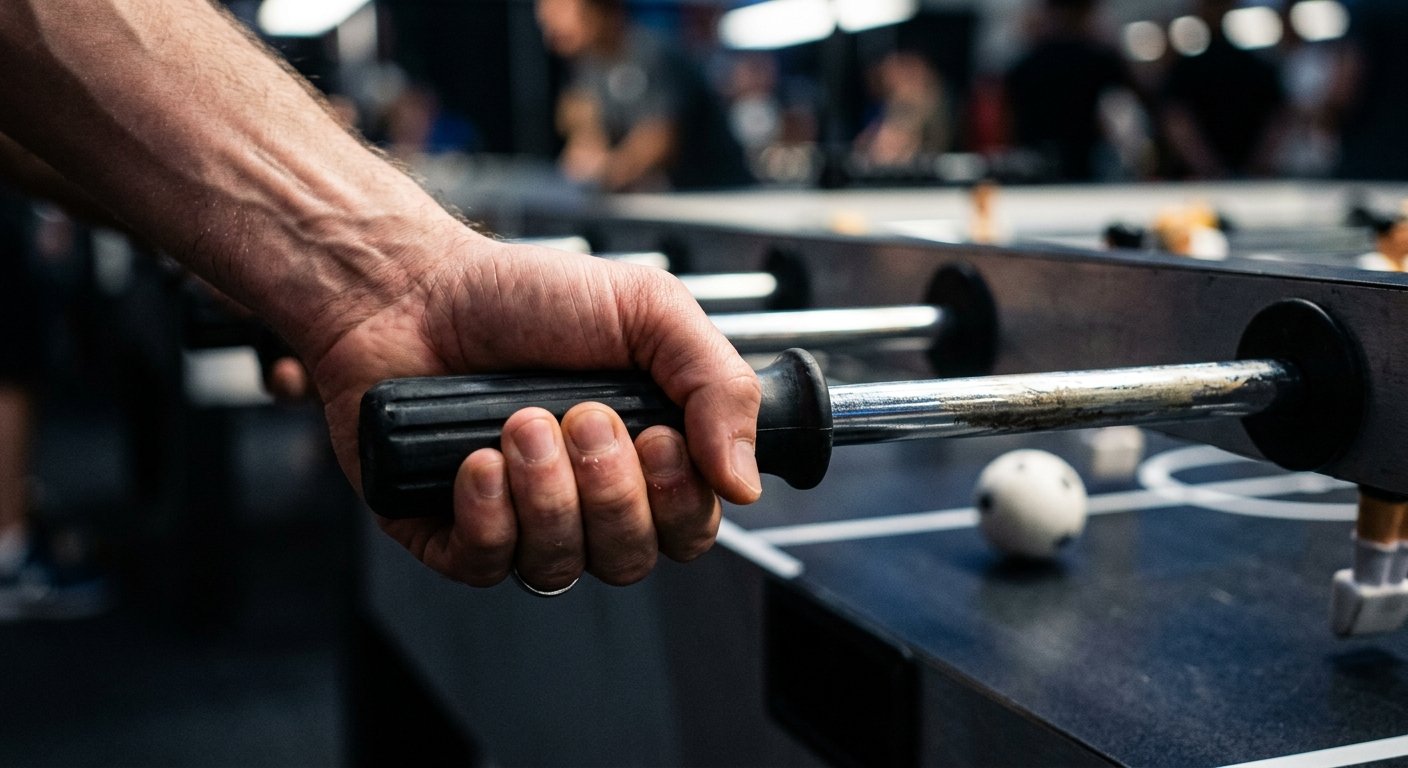
Walk into any serious Tornado tournament — the kind run through USA Foosball (USTSF) or sanctioned by the ITSF — and you’ll notice that elite 3-bar offense comes down to two shots almost exclusively: the pull shot and the snake shot. Sure, players also work push shots, spray angles, and lane shots off the 5-bar (the middle rod with five men). But when it’s a tight game and you need a goal, most players are reaching for one of these two weapons.
If you’re past the “random spinning and hoping” stage and ready to build a real offensive system, understanding exactly how each shot works — mechanically, not just conceptually — is the starting point. Let’s break them down side by side.
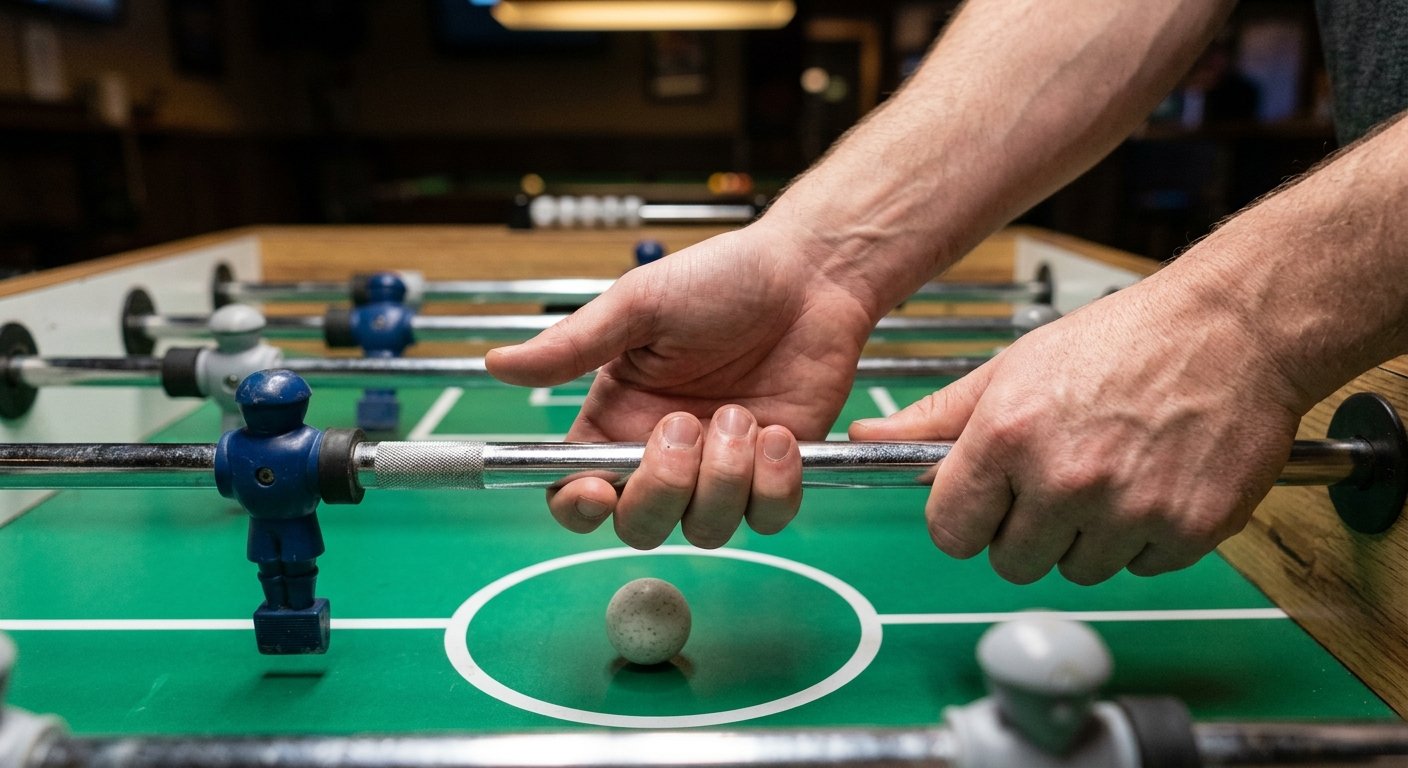
The pull shot is a lateral-then-forward motion. You slide your 3-bar (the three-man rod, your primary offensive rod on a Tornado table) to one side by pulling the rod toward your body, then fire the ball straight through the open lane created by that lateral movement. The ball travels from the middle set position into a corner that your opponent’s goalie wasn’t covering a split second ago.
Use a standard open-palm grip — rod resting between your thumb and index finger, palm facing down, wrist relaxed. Your shooting man (the center man on the 3-bar is most common) sets up with the ball at rest beside its foot in the middle position, or just slightly off-center. This is the set — the ball sits still on the playfield with the man’s foot next to it. The ball is never pinned on a pull shot; that’s snake-shot territory.
From the set, your lateral movement is the pull (toward your body) or push (away from your body). For the pull shot specifically, you’re dragging the rod toward your hip, then snapping forward. That snap is a wrist flick, not an arm swing. Keep the elbow low and loose.
The pull shot is forgiving because the ball sits set at your man until you’re ready to shoot. You control the timing completely. There’s no complicated rollover motion to manage simultaneously with the lateral move. You build lateral quickness, wrist snap, and lane-reading habits — all skills that transfer directly into the snake shot later. Most players at the bar-league level have never seen a truly consistent pull shot, which means even a polished beginner version wins a lot of points.
The snake shot (rollover) is a different animal. Unlike the pull’s open set, this is where pinning actually enters the game: you pin the ball against the table with the front face of your 3-bar man, then roll the rod forward and backward (hence “rollover”) while simultaneously moving it laterally. The rotation and the lateral movement combine to release the ball in a direction that’s extremely hard for a goalie to predict or react to in time.
It’s faster than the pull shot at the elite level, and the shooting angles it opens are more extreme. That’s why it dominates at the top of the competitive game.
This is where the snake shot gets complicated. You use a wrist-over grip rather than the standard open-palm. The rod rests in the crook of your wrist and palm with your hand wrapped over the top, not under. Some players describe it as holding the rod like a bicycle handlebar you’re about to rotate forward.
The ball is trapped — held between the playing surface and the toe or front face of the man — with very light downward pressure. Too much pressure and the ball won’t release cleanly. Too little and it squirts out before you’re ready. Finding that sweet spot is the core skill challenge of the snake shot, and it’s exactly why this shot takes longer to develop than the pull.
| Factor | Pull Shot | Snake Shot |
|---|---|---|
| Grip | Open palm, rod under hand | Wrist-over, rod across palm |
| Ball control method | Open set (ball at rest by the foot — no pin) | Front pin (front face, light pressure) |
| Lateral motion | Pull or push then shoot | Simultaneous roll + slide |
| Learning curve | Lower | Higher |
| Ceiling speed | Very fast | Extremely fast |
| Best table | Works on most tables | Optimized for Tornado |
If you’re methodical, like having control of timing, and prefer to read your opponent before committing — the pull shot fits your game. Many elite players built entire careers on a devastating pull/push system and never needed the snake to win at high levels.
If you’re explosive, thrive on unpredictability, and enjoy a shot that’s almost un-guardable when fully developed — the snake is your long-term weapon. But be patient. Expect weeks of trap practice before the shot starts consistently hitting the goal rather than the ceiling.
Ideally? You learn both. The best 3-bar players in the game can switch between them mid-series, which makes defending them nearly impossible. That’s the real goal: a pull/push/snake system that keeps your opponent guessing on every possession.
Understanding how this competitive skill landscape developed is also worth your time — the history of competitive foosball explains why the Tornado table became the US standard and how the modern 3-bar game evolved into what you see in tournaments today.
Set up in the middle set position. Practice the lateral pull 2 inches, then shoot — don’t look at the corner, just fire straight. Do 20 reps pulling left, 20 reps pulling right. Then add a fake: pull left, pause one beat, pull right and shoot. Fakes are where points actually come from. Aim for 15 minutes of focused pull-shot reps per practice session.
Don’t shoot at first. Just practice the trap. Set the ball, trap it, slide the rod side to side slowly without losing control. Do this for 5–10 minutes every session until the ball stops escaping. Then add a single, slow rollover release. Accuracy before speed — always. Once you’re hitting the goal 70% of the time slowly, start adding pace.
Check the Foos Central video library for technique breakdowns that let you see the grip and wrist motion in real time — much easier than reading about it.
The main offensive shots on the 3-bar are the pull shot, push shot, snake shot (rollover), and lane shot (straight through without lateral movement). From the 5-bar, players use the brush pass, tic-tac (wall-to-wall passing), and spray shot. The 2-bar goalie also has a long kick shot. Most competitive systems focus on mastering two or three shots deeply rather than collecting many shots at surface level.
The snake shot is widely credited to Todd Loffredo, one of the most decorated players in US foosball history. Loffredo is reported to have developed and popularized the rollover technique, and its effectiveness at the competitive level eventually made it a standard part of elite 3-bar offense. His influence on the modern game is hard to overstate.
The “22 snake” refers to a specific shooting position — the ball is set up two men from the wall on the 3-bar, and the shot is released two positions over (toward the center). It’s a positional notation used by advanced players to practice and communicate exact ball placement and shooting angles. Position numbers help players build consistent, repeatable shot lanes rather than shooting from random spots on the rod.
A power shot (sometimes called a straight shot or lane shot) is fired directly forward from the 3-bar without lateral movement. The key is a fully relaxed grip before the shot — tension in the forearm kills speed. From the pull set — ball at rest, never pinned — relax your hand almost completely, then snap the wrist forward explosively. Counterintuitively, a looser grip generates more speed than a tight one. Power shots are most effective when your opponent’s goalie is caught flat or between positions.
The pull shot and snake shot are the two pillars of competitive foosball offense — and now you know exactly how each one works, which one to tackle first, and how to structure your practice time. There’s no shortcut: both shots require deliberate, focused reps on a quality table. If you’re playing on a Tornado — the competitive standard in the US — you’re on the right equipment for both shots to fully develop.
Find a table near you, a local league to test your new shot against real opponents, or an upcoming tournament where the pressure will sharpen everything fast. Browse the Where to Play directory to find rooms and leagues, or check upcoming tournaments and get in the bracket. Find a table. Learn the shot. Enter the bracket.

Foos Central is your home for everything foosball: where to play, tournaments and results, rules and techniques, tables and gear, and a Youth Program putting tournament-grade Tornado tables in schools. Run by lifelong player Damon Delcoro, it exists to grow the sport and to be the best-written foosball resource online. Visit fooscentral.com →
Grow the game
We put tournament-grade Tornado tables where kids can reach them. Bring the Youth Program to a school near you, or find a table and play tonight.