
Foosball Wall Pass vs. Brush Pass
The wall pass and the brush pass are the two fundamental ways to move the ball from your 5-bar (midfield rod) to your 3-bar…
Foosball tournaments follow a format built around draw systems, bracket play, and a national points structure governed by USA Foosball (USTSF).
Foosball tournaments follow a format built around draw systems, bracket play, and a national points structure governed by USA Foosball (USTSF). Players register by event type — singles, doubles, or mixed — get paired through draws or seeding, then compete in double-elimination or round-robin brackets. Beginners can enter ranked events at any skill level. This guide walks you through every step, from signing up to reading the results board.
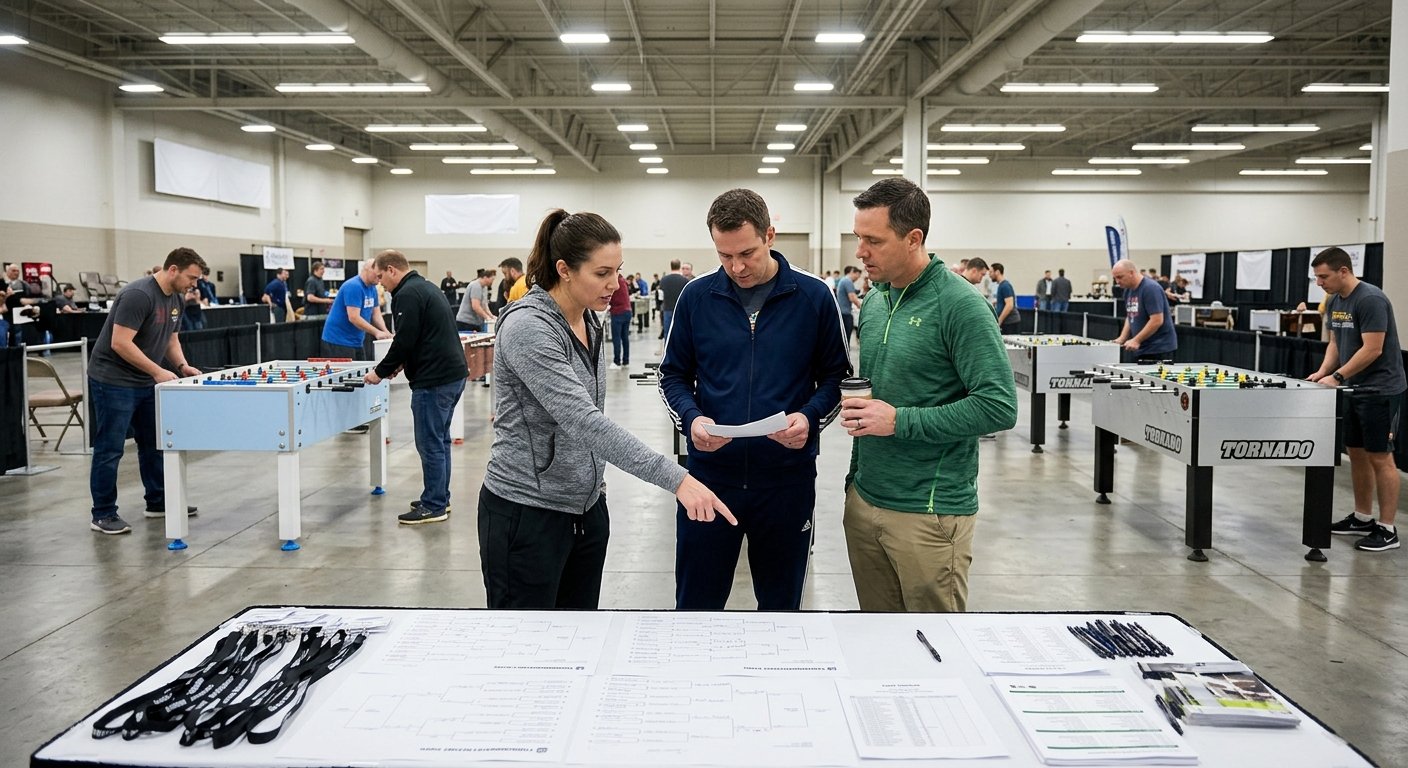
Before you walk into your first event, it helps to know who’s running the show. In the United States, competitive foosball is organized primarily through USA Foosball / USTSF (usafoosball.com), which sanctions tournaments, maintains national rankings, and trains referees. Think of USTSF as the USTA of foosball — the national governing body that keeps the competition ecosystem intact.
At the international level, the sport is governed by the International Table Soccer Federation (ITSF), which oversees World Championships, Continental Championships, and the ongoing effort to earn Olympic recognition. Foosball is not an Olympic sport — not yet — but the ITSF has been actively pursuing IOC recognition, and the sport’s global participation numbers keep growing.
For any serious tournament in the US, you’ll be playing on a Tornado table. Manufactured by Valley-Dynamo, Tornado has been the competitive standard since the professional era of the 1970s wound down — when a Seattle-based company called Tournament Soccer ran what was widely reported as a tour paying out roughly a million dollars a year at its peak. That era set the template; Tornado carried the torch. If you want to compete, get comfortable on a Tornado.
If your home practice table isn’t a Tornado, try to find bar time or league time on one before your first tournament. The rod tension, ball weight, and men feel noticeably different from recreational tables. Foos Central’s Where to Play directory lists venues in Boca Raton, Fort Lauderdale, West Palm Beach, and Miami where you can get that table time.

The DYP (Draw Your Partner) is the format most beginners encounter first, and honestly, it’s one of the best entry points in competitive sports. You pay your entry fee, your name goes into a hat (or an app), and you’re randomly paired with a doubles partner for that round. Win enough, and you may draw a different partner for the next bracket. Lose and you’re done — until the next DYP, which might start 90 minutes later at the same event.
Why does this format work so well? Because skill level becomes part of the strategy rather than a barrier. A strong player can carry a weaker partner; a weaker player gets tournament reps against real competition; and nobody sits out all day waiting for bracket assignments. It also means you can show up solo — no pre-arranged teammate required.
BYP (Bring Your Partner) is the traditional doubles format where you register with a pre-selected partner. This is where established teams compete, chemistry matters, and communication — knowing whose ball it is on the 3-bar, when to pass versus shoot — becomes a real factor. BYP events tend to carry more ranking points and draw stronger fields.
Exactly what it sounds like: one-on-one, goalie to goalie, no partner to bail you out. Open Singles is where individual technical depth gets exposed. Your pull shot (a horizontal rod movement pulling the ball and shooting in one motion), your snake/rollover (pinning the ball under the man’s toe and rotating through a kick), your defense reads — all of it gets tested with nobody else to cover.
| Format | Team Size | Best For | Partner Required? |
|---|---|---|---|
| DYP | 2 (random pair) | Beginners, solo entrants, quick events | No |
| BYP | 2 (pre-selected) | Established pairs, higher-stakes doubles | Yes |
| Open Singles | 1 | Individual skill development, competitive singles players | No |
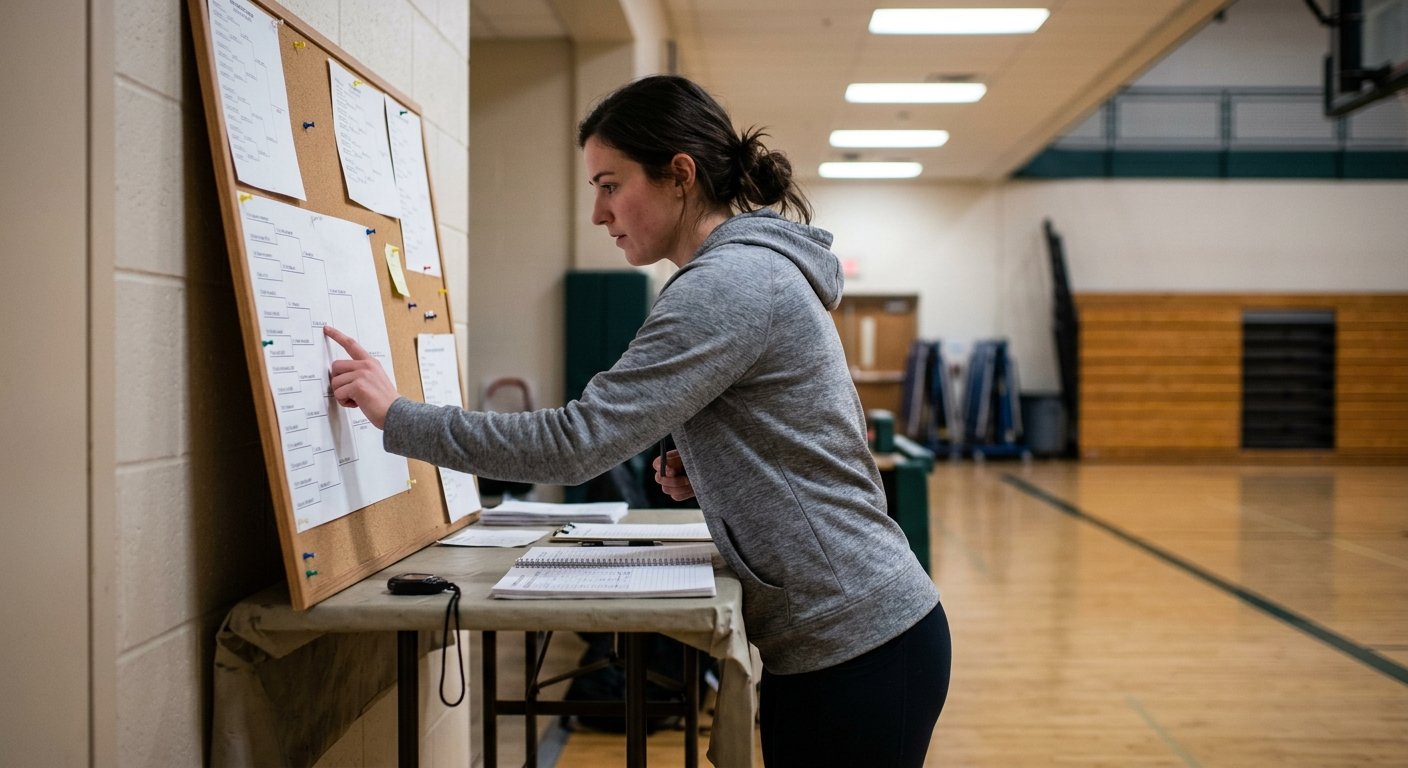
Most USTSF-sanctioned events use double-elimination brackets. You get two lives: lose once and you drop into the losers’ bracket. Lose again and you’re eliminated. This structure rewards consistency and mental resilience — you can take an early L against a ranked player, regroup, rip through the consolation side, and still win the event. It’s happened. It will happen to you eventually, in one direction or the other.
Some events, particularly smaller local DYPs, use round-robin pools followed by single-elimination finals. Round-robin means you play every other team in your pool, accumulating wins; top finishers advance. It’s a friendlier format for beginners because you’re guaranteed multiple games regardless of early results.
Sign up for specific events (DYP, Open Singles, BYP) and pay entry fees. Check how-to-register if it’s your first USTSF event — you’ll need a membership.
For DYPs, partners are drawn randomly. For BYP and singles, seeding may be applied based on current national rankings to avoid top players meeting in round one.
Matches are typically best-of-five games to five points (with a win-by-two rule at 4-4). A referee or table monitor oversees play and enforces the ruleset — no spinning, no jarring, specific serve rules.
In double-elimination, your first loss drops you to the consolation bracket. Second loss, tournament over for you. Winners bracket and losers bracket converge in finals.
Finishes are reported to USTSF. Points post to your national ranking based on placement and the event’s sanctioned weight. Check your points lookup after the event.
Every USTSF-sanctioned event awards points based on placement. The better you finish and the larger the event, the more points you earn. Points accumulate across the calendar year and determine your national ranking — which, in turn, affects seeding at future events and eligibility for year-end championships.
Rankings are split by event type: you can be ranked separately in Open Singles, Open Doubles, and Mixed Doubles (a male-female pair). Some players are elite in one format and mid-pack in another. Your ranking follows you; it’s not reset after each tournament. This creates an interesting long-game dynamic where consistency across a full season matters as much as winning any single event.
Your ranking follows you across the full season — consistency matters as much as winning any single event.
At the international level, ITSF maintains its own world ranking system for players competing in globally sanctioned events. Top US players often compete at both levels, accumulating USTSF domestic points and ITSF world ranking points simultaneously. The systems are separate but complement each other for players serious enough to travel internationally.
USTSF membership is required to earn ranking points at sanctioned events. Annual membership is straightforward to set up through usafoosball.com. Without it, you can still enter some open events but your finishes won’t post to the national ranking.
Tournament foosball has a real ruleset — it’s not “anything goes.” The key rules beginners trip over most often:
You can look up the complete official ruleset at fooscentral.com/resources/rules. Reading the rules once before your first event will save you a penalty at a critical moment.
South Florida has an active tournament scene across Boca Raton, Fort Lauderdale, West Palm Beach, and Miami. Events range from casual weekly DYPs at local venues to fully sanctioned USTSF regional and national qualifiers. The upcoming tournaments page at Foos Central keeps a current calendar for this area, and the results archive shows you who’s been competing and how events have played out.
For a first-timer: start with a DYP. Entry fees are generally low, the format is beginner-friendly, and you’ll get multiple games in a single session. Show up early, watch a few matches before yours, and introduce yourself — the foosball community is genuinely welcoming to new players who come in ready to learn rather than ready to complain about losing.
Competitive foosball isn’t just for adults. The Foos Central Youth Program places tournament-grade Tornado tables in South Florida schools, giving young players access to the same equipment used in sanctioned competition. Students who learn on a Tornado are ready for real tournament play — not a surprise given that muscle memory built on a proper table transfers directly to competitive settings.
ITSF runs youth divisions at its major events, and USTSF supports youth participation in domestic competition. If you’re a parent, coach, or school administrator in Broward, Palm Beach, or Miami-Dade County, the Youth Program is worth exploring — it’s one of the most direct paths to building a new generation of tournament players from the ground up.
DYP stands for Draw Your Partner. It’s a doubles format where you’re randomly paired with a partner for each bracket rather than competing with a pre-selected teammate. It’s the most beginner-friendly tournament format because you can enter solo, you’re guaranteed competitive games, and skill imbalances between partners are part of the strategic challenge rather than a disadvantage.
For fully sanctioned USTSF events where your finish posts to national rankings, yes — you need an active USTSF membership. Some local or open events allow non-members to enter, but your results won’t count toward national ranking points. Membership is available through usafoosball.com and is straightforward to set up.
Points are awarded at each USTSF-sanctioned event based on your placement and the event’s sanctioned weight. You accumulate points across the year in each event type — Open Singles, Open Doubles, DYP — and those totals determine your national ranking. Higher rankings affect your seeding at future events and eligibility for national championships.
Not yet. The ITSF has been actively pursuing IOC recognition, and the sport has a strong global competitive structure — World Championships, continental events, and national federations in dozens of countries. The case is real and growing. But as of 2026, foosball is not an official Olympic sport.
In the United States, the Tornado table (made by Valley-Dynamo) is the competitive standard at USTSF-sanctioned events. ITSF-sanctioned international events may use other approved tables depending on the host federation. If you’re training for US tournament play, practicing on a Tornado is the right call.
Check the current event calendar, learn how to register, and find a Tornado table near you in South Florida — everything you need to go from curious to competing is right here.
Grow the game
We put tournament-grade Tornado tables where kids can reach them. Bring the Youth Program to a school near you, or find a table and play tonight.